
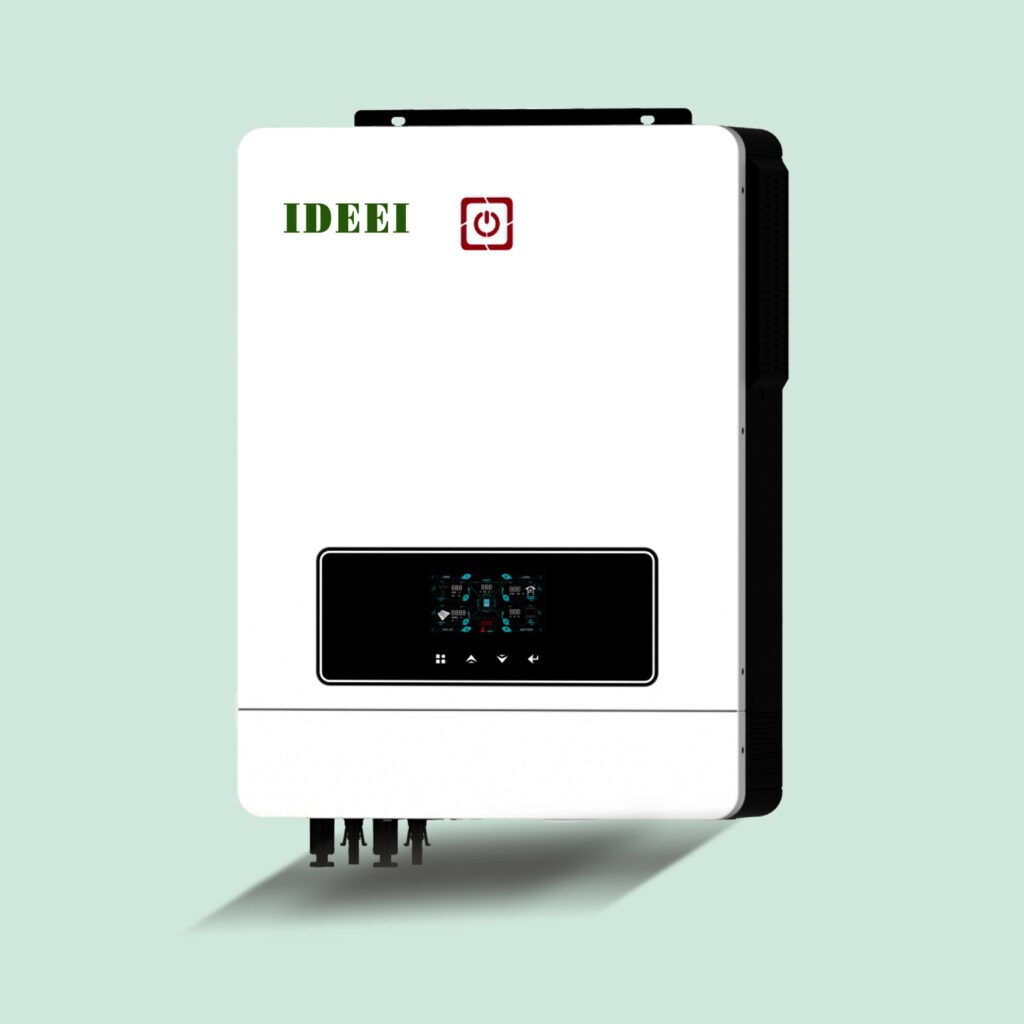
The first question buyers ask about a hybrid solar inverter in 2026 is no longer about efficiency. It is: “Will it keep working when the grid goes down?” Hybrid inverter enquiries have surged as outages, tariff changes and unreliable rural grids push homes, farms and small businesses toward systems that blend solar, battery and grid into one managed supply. This buying guide covers the three specifications that actually decide whether a hybrid system performs — the MPPT solar input, the battery voltage, and the backup switching time — and shows how they map onto the IDEEI QB off-grid range from 4.2 kW to 10.2 kW.
What Makes a Hybrid Solar Inverter Different?
A conventional on-grid inverter shuts down the moment the grid fails, because it must never energise a dead network. A purely off-grid inverter ignores the grid entirely and runs everything from batteries. A hybrid solar inverter sits between the two: it connects to the grid, charges batteries from solar (and from the grid when needed), and — critically — forms its own islanded output during an outage so backed-up loads keep running.
That behaviour makes the hybrid design the natural choice wherever the grid exists but cannot be trusted: peri-urban homes, clinics, telecom sites, farms with cold storage, and workshops where a stalled machine costs more than the inverter. If your site has no grid at all, a dedicated off grid solar inverter configuration of the same QB platform covers you; if the grid is present, the hybrid mode uses it as a charger and a safety net rather than a master.
MPPT Inputs: The Solar Side of a Hybrid Solar Inverter
The MPPT charge controller built into a hybrid solar inverter decides how much of your array’s energy actually reaches the batteries and loads. Three checks matter when comparing models:
- PV input voltage window: the array string voltage must sit inside the MPPT range across seasons. A wider window gives more freedom in panel layout.
- Maximum solar charging power: this caps how large an array the inverter can harvest from. Oversizing the array modestly (around 1.2–1.3×) improves morning and cloudy-day yield, but only if the controller can use it.
- Number of trackers: two independent MPPT inputs let east- and west-facing strings, or shaded and unshaded strings, each work at their own optimum. On single-tracker models, keep all panels in one orientation and tilt.
In the IDEEI QB range, solar input capacity scales with model size, so the array plan and the inverter choice should be made together — a 10.2 kW system that can only harvest 6 kW of PV is a bottleneck designed in at purchase.
24V or 48V? Battery Voltage Sets the Ceiling
Battery voltage is the least glamorous and most consequential decision in a hybrid system. At 24V, cables carry twice the current for the same power, losses rise, and practical system size tops out around 4–5 kW. At 48V, current halves, efficiency improves, and 6–10 kW systems become straightforward. The QB range follows this logic exactly:
| Model | Rated output | Battery voltage | Typical application |
|---|---|---|---|
| QB42-24 | 4.2 kW | 24V | Small homes, cabins, shops — lights, fans, TV, router, fridge |
| QB62-48 | 6.2 kW | 48V | Family homes, offices, small guesthouses |
| QB82-48 | 8.2 kW | 48V | Larger homes, clinics, workshops with motor loads |
| QB102-48 | 10.2 kW | 48V | Small commercial sites, farms, multi-load properties |
Choose 24V only when the load list is genuinely small and unlikely to grow. Most buyers who “will add a pump and an air conditioner later” should start at 48V: changing battery voltage later means replacing the inverter, not just adding batteries. The QB-Hi series extends the same hybrid platform for projects that need a higher-power off-grid frame.
Backup Switching Time: The Spec That Decides What Stays On
When the grid fails, a hybrid solar inverter must detect the loss, disconnect from the network and take over the load. The gap is the switching (transfer) time. For lighting, refrigeration and most appliances, anything under about 20 milliseconds is invisible. Computers, routers and medical or IT equipment prefer UPS-grade switching of about 10 ms, so check which class your model actually delivers rather than assuming every hybrid is UPS-grade.
When comparing datasheets, check three things: the stated transfer time in backup mode, whether the rated backup output equals the normal output or is derated, and the surge rating. Motor loads — pumps, compressors, workshop tools — draw a heavy start-up surge; a hybrid inverter that cannot surge will trip exactly when the fridge compressor and the well pump start together. Match the inverter’s surge capacity against your largest simultaneous motor start, not just the sum of nameplate watts.
Sizing the Rest: Loads, Autonomy and Growth
With the big three decided, finish the specification in this order. First, list the loads that must run during an outage and total their watts — this sets the inverter size. Second, decide autonomy: how many hours those loads must run without sun, which sets battery capacity in kWh. Third, size the array to refill the battery on an average day while also carrying daytime loads. Finally, leave growth room: the most common hybrid regret is an inverter bought exactly at today’s load. Stepping one model up in the QB range (for example from the QB62-48 to the QB82-48) is far cheaper than a second system later.
Warranty, Documentation and Support
The final buying checks are unglamorous and decisive. Confirm the warranty term in writing — IDEEI hybrid inverters are backed by a 2-year warranty — and check what it covers: parts only, or advance replacement for distributors? Ask for the full manual before purchase, not after installation; the parameter list tells you more about a hybrid inverter’s real capability than the brochure does. Confirm that firmware, monitoring options and spare boards will remain available for the model’s lifetime, and that your supplier can support parameter configuration for your battery type, whether lead-acid or lithium. A slightly cheaper inverter with no documentation trail and no support channel is the most expensive model in any catalogue. Buyers comparing the QB range for distribution should also confirm packaging, labelling and OEM options at quotation stage, so the specification you test is the specification that ships.
How to buy a hybrid solar inverter, step by step
Work through this checklist in order; each step changes the answer to the next one, so do not start from a model name.
- List the loads that must run in an outage, and total their watts. This sets the inverter size, and it is the only honest starting point.
- Decide autonomy in hours, then convert it to battery capacity. Backup watts multiplied by autonomy hours gives the energy the battery must deliver; for the kWh-to-Ah conversion and the sizing traps, see hybrid inverter battery capacity in kWh and Ah.
- Choose 24V or 48V before you choose a model. Choose 48V for a whole house or any load list that may grow, because changing voltage later means replacing the inverter. For the full upgrade route, see the 24V or 48V whole-home solar upgrade path.
- Match the MPPT window and the array to the model. Check the PV input voltage window across seasons, the maximum solar charging power, and whether one or two trackers are needed for your roof orientations. A modest array oversize of around 1.2–1.3× only helps if the controller can use it.
- Check switching time and surge against your sensitive and motor loads. Confirm the stated transfer time, whether backup output is derated, and whether the surge rating covers your largest simultaneous motor start.
- Confirm warranty, manual and support in writing before ordering. Confirm the 2-year warranty terms, ask for the full manual, and confirm battery-type configuration support for lead-acid or lithium.
Frequently Asked Questions
Does a hybrid solar inverter need a battery to work?
A battery is strongly recommended — it is what carries loads through the switching moment and the night. Some hybrid systems can run in a batteryless mode with solar and grid blending, but backup during an outage then depends entirely on sunshine at that moment. For genuine outage protection, budget for at least a modest battery bank.
Is 24V or 48V better for a whole house?
For a whole house, 48V. A 24V off grid inverter suits small, defined load lists up to about 4 kW. Above that, 48V systems run cooler, lose less energy in cabling, and give you access to the 6.2–10.2 kW models most houses actually need once pumps and air conditioning are included.
Can a hybrid solar inverter run a water pump or motor?
Yes, provided the surge rating covers the motor’s start-up current. Check the inverter’s peak/surge specification against the largest motor, avoid starting several motors simultaneously, and consider a soft-start arrangement for very large pumps.
Can I start with a 24V system and just add batteries later to upgrade to 48V?
No, and this is the trap. Adding batteries does not change the inverter’s battery voltage: a 24V inverter cannot become a 48V inverter by adding cells, and the upgrade means replacing the inverter and reconfiguring the battery bank. If whole-home use or larger loads are likely in future, choose 48V at the start, and read the 24V or 48V whole-home solar upgrade path before ordering.
How much battery capacity do I need, in kWh or Ah?
Start from backup loads, not from a round-number battery size: multiply the watts that must run in an outage by the hours they must run without sun, and that energy figure is your kWh need. The Ah figure then depends on the system voltage you chose, so a 48V bank needs half the Ah of a 24V bank for the same kWh. See hybrid inverter battery capacity in kWh and Ah for the conversion and the common sizing mistakes.
Should I just buy the biggest hybrid inverter now to be safe?
Not automatically. Stepping one model up for growth room is sensible, but jumping far beyond your load list wastes money and can leave the array and battery mismatched to the inverter. Size from the outage load list first, add one step of growth room if the load list is likely to grow, and confirm the step with the supplier against your array and battery plan.
Planning a hybrid system for 2026? Share your load list and outage pattern with IDEEI — our team will recommend the right QB model, battery voltage and array size for your site, with no obligation. Contact IDEEI for hybrid inverter advice. You can also browse the full range on our products page.