
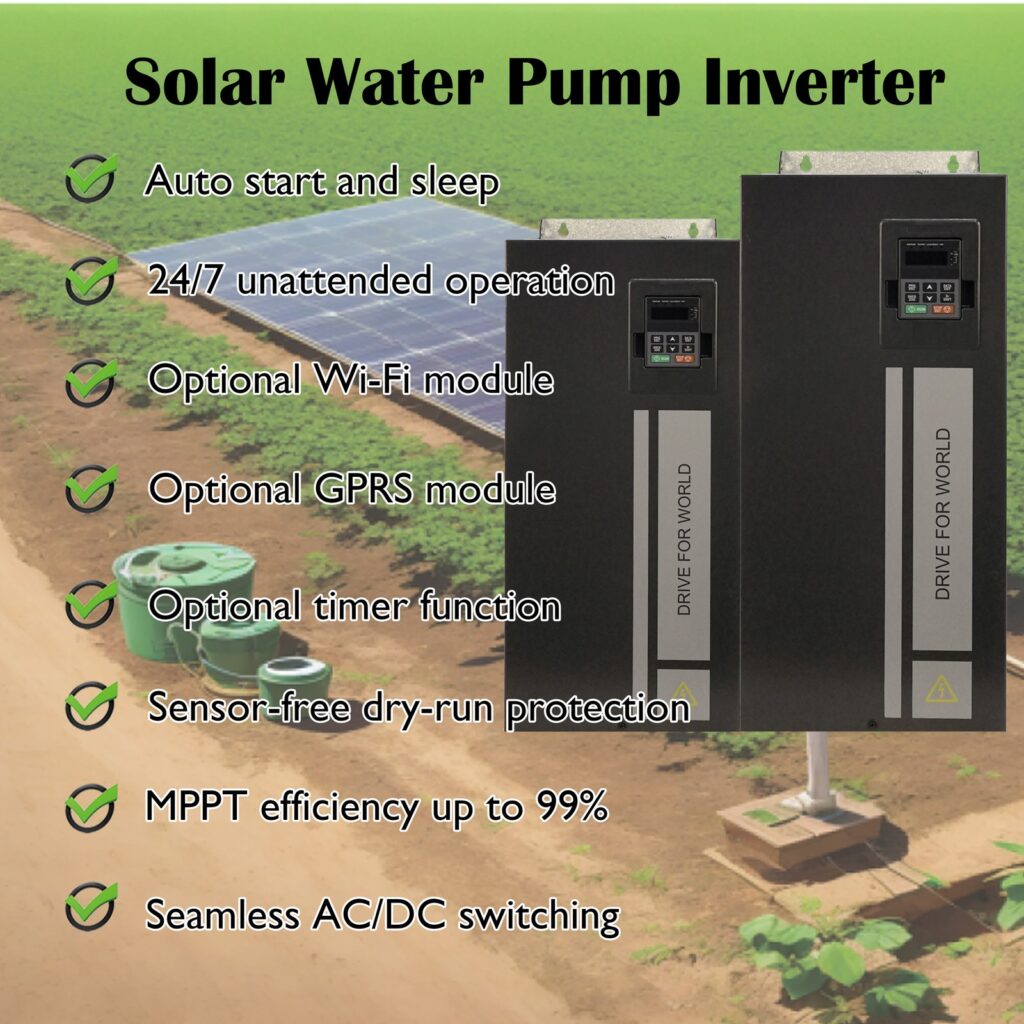
Yes — a solar inverter without a battery is not only possible, it is the standard architecture for one of solar’s oldest jobs: pumping water. Batteries are the most expensive and shortest-lived part of most solar systems, so engineers have spent decades learning how to run loads directly from the panels. This article explains how batteryless operation actually works, where it performs brilliantly, where it falls short, and how modern hybrid inverters let you start batteryless and add storage later. For a load-by-load decision on hybrid systems, see our guide to which loads a hybrid inverter can run without a battery during the day.
How a Solar Inverter Without a Battery Powers Loads Directly
A battery-free system removes the storage stage entirely. The photovoltaic array feeds DC power to the inverter, the inverter converts and conditions it, and the load consumes it in real time. Output rises with the morning sun, peaks at midday and falls in the evening — the load simply follows the energy available.
Two technologies make this practical. The first is MPPT (maximum power point tracking), which continuously adjusts the array’s operating point so the inverter extracts the most power from whatever light is available, rather than demanding a fixed battery-like voltage. The second is the variable-frequency drive itself: instead of requiring full power or nothing, a VFD can run a motor at partial speed. A pump at 70% speed still moves a useful volume of water, so the system degrades gracefully under cloud instead of switching off.
Solar Water Pumping: The Classic Batteryless Application
Solar pumping solved the storage problem with a simple insight: store water, not electricity. A tank or reservoir filled during sunny hours is, in effect, a battery — one that never wears out, needs no replacement and costs a fraction of an electrochemical bank. That is why solar pump inverter systems such as the IDEEI QB100-PV are designed to run batteryless by default, driving the pump directly from the array through an MPPT controller.
The QB100-PV ranges cover the full span of these applications: the S2 (0.75–5.5 kW, 220V) and SS2 (1.5–5.5 kW, 220V) ranges for single-phase pumps on small and medium farms, and the 1.5–37 kW and 45–280 kW (400V) ranges for three-phase commercial and utility pumping. The same logic extends to livestock watering, irrigation and remote water supply: wherever demand follows the sun, a battery adds cost without adding water.
Many QB100-PV installations add one refinement — an AC input with automatic AC/DC switching. When sunlight is insufficient, the drive can top up from the grid or a generator and return to solar when the sun recovers, still with no battery in the loop.
Hybrid Inverters With and Without Batteries: Two Modes Compared
For homes and businesses, the question is subtler. A hybrid solar inverter is normally paired with batteries, but models in the IDEEI QB off-grid range can also be configured to run without them, blending solar and grid power to serve daytime loads directly. The two modes are not equal:
| Batteryless mode | With battery storage | |
|---|---|---|
| How it works | Loads run from PV in real time; grid fills any gap | PV charges the battery; battery carries loads on demand |
| During a grid outage | Only as much power as the sun is providing at that moment | Backed-up loads run normally, day or night |
| Best for | Daytime loads: pumping, irrigation, workshops, cooling | Whole-property backup, night loads, critical equipment |
| Main limits | No night operation; output follows the weather | Battery cost, replacement cycle, more complex system |
| Upgrade path | Batteries can be added later on the same inverter | Already includes storage; expand by adding capacity |
The practical takeaway: batteryless is a legitimate starting configuration, not a compromise to be embarrassed about — provided the loads genuinely follow the sun. The next section turns that condition into a check you can run before committing.
When You Still Need a Battery
Three situations defeat batteryless design. First, night-time load: lighting, refrigeration and security cannot wait for sunrise. Second, critical load: medical refrigeration, communications and any load that must never lose power need stored energy or a backed-up supply. Third, loads that demand stable power regardless of weather: a process that cannot slow down, pause or shift to daylight hours is a poor fit for a system whose output follows the sky.
How to Check Whether Your Loads Can Go Batteryless
- List every load with its running hours. Mark each one as daytime-only, night-time, or must-never-stop. Anything in the last two groups needs a battery or another backed-up supply.
- Separate loads that can pause, slow down or shift from loads that cannot. Pumping, irrigation, daytime cooling and daytime workshop work can usually follow the sun; refrigeration, security and clinic cold storage cannot.
- Check starting load, not just running load. Motors draw more at start-up, and a batteryless system must still start the load on the solar power available at that hour.
- Test the cloudy-afternoon case, not just the sunny-midday case. Ask what happens to each load when output falls for an hour: does the job slow gracefully, pause harmlessly, or fail?
- Confirm the grid top-up path where one exists. A hybrid inverter can blend grid power when a cloud passes, but only if a grid connection is available and the inverter is configured for grid blending.
- Plan the battery route before you need it. On a hybrid inverter, note the battery voltage and capacity you would add later, so a batteryless start does not become a dead end. For the detailed load lists behind this checklist, see which loads a hybrid inverter can run without a battery during the day.
Where Batteryless Pays Back Fastest
The economics explain why the batteryless architecture keeps winning projects. Removing the battery removes the component that needs replacement, and what remains is panels, the inverter and the load, all of which are long-life assets. The payback is fastest where three conditions coincide: demand that peaks with the sun, such as irrigation, livestock watering, daytime cooling and workshop machinery; an existing storage buffer, such as a water tank, a cold room’s thermal mass or simply a production schedule that can shift to daylight hours; and electricity or diesel costs high enough that every solar kilowatt-hour displaces real money. Farms across Africa, the Middle East and Latin America have run this calculation for years, which is why direct solar pumping — not battery storage — became the default design for agricultural water. For mixed sites, the hybrid route preserves the option: run batteryless now, add storage the season the load profile changes.
Frequently Asked Questions
Will a batteryless solar system work on cloudy days?
It will work at reduced output. A pump driven through a VFD slows down rather than stopping, so a cloudy day might deliver 30–60% of the normal water volume. What a batteryless system cannot do is shift energy to the evening — if your demand peaks after sunset, you need storage or a grid connection.
Can I add batteries to a batteryless system later?
With a hybrid inverter, yes — that is one of the strongest reasons to choose hybrid architecture. Start with solar and grid blending, then add a battery bank when budget or outage experience justifies it. A dedicated solar pump inverter is different: pumping systems usually stay batteryless by design, because the water tank already does the storage job.
Does a solar pump inverter ever need a battery?
Almost never for the pumping itself. Batteries appear in pumping projects only for auxiliary loads — lighting, controls or a caretaker’s house — and those are normally served by a separate small system, keeping the pump drive simple, efficient and batteryless.
On a cloudy day, will a batteryless water pump still work as normal?
No — this is the trap in batteryless pumping. The pump will keep running, but not as normal: it slows down, delivers less water, and under heavy cloud it may stop until the sun recovers. A tank sized for sunny-day output can hide a short cloudy spell, but it cannot turn a cloudy day into a normal one. If daily water volume is a hard requirement regardless of weather, add tank capacity or a grid top-up path rather than assuming batteryless output is constant.
Which daytime loads can a hybrid inverter run without a battery?
Loads that can pause, slow down or shift to daylight hours: irrigation and water pumping, daytime cooling and ventilation, and daytime workshop processing. Loads that must run at night or must never lose power — night lighting, cold storage, security, clinic refrigeration and communications — still need a battery. Our companion guide lists both groups load by load: which loads a hybrid inverter can run without a battery during the day.
Thinking of skipping the battery? Tell IDEEI what you need to run and when you need to run it, and we will tell you honestly whether a batteryless QB100-PV or QB hybrid configuration fits — or whether your loads really do need storage. Contact IDEEI for system advice.