
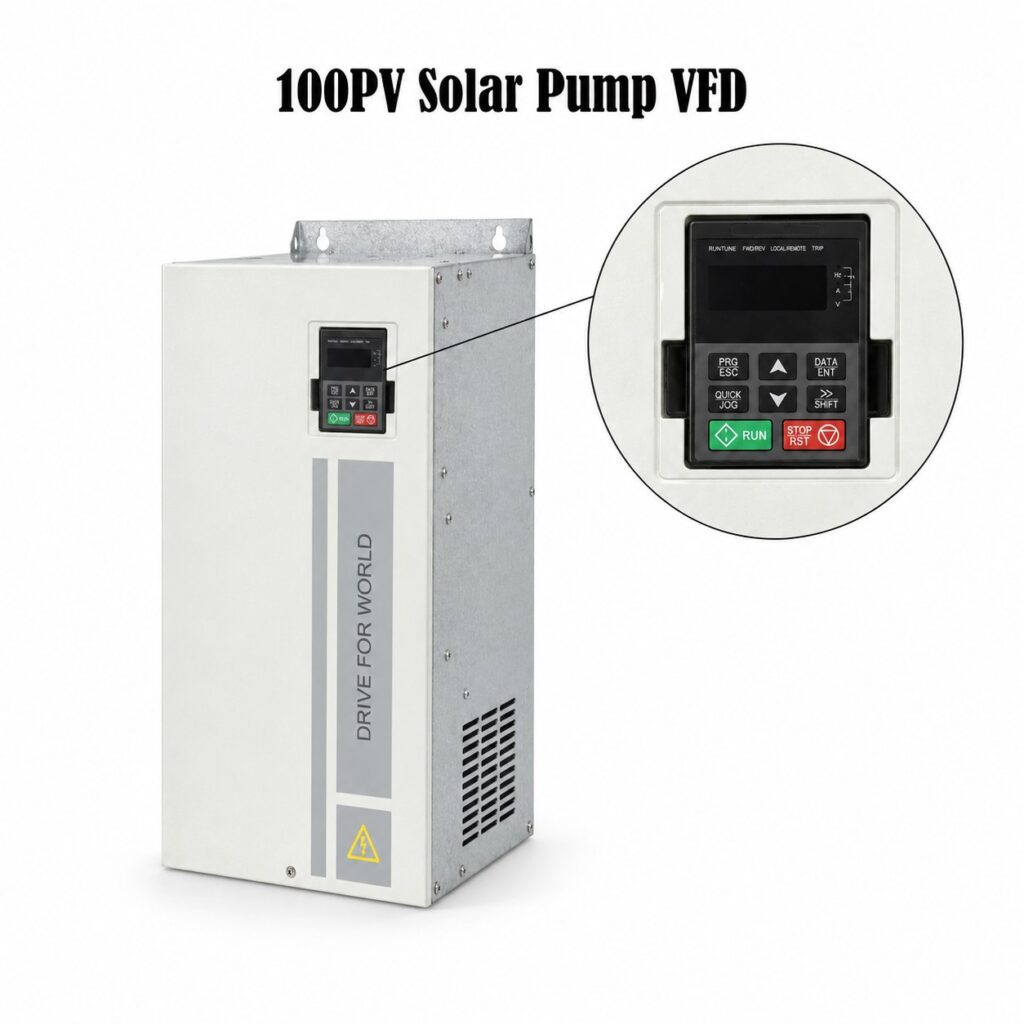
A solar pump inverter that trips is usually not broken — it is reporting. Every fault indication on the display is the drive protecting an expensive submersible motor from a condition that would destroy it: too little voltage from the array, too much current in the windings, or a pump spinning in an empty borehole. This guide explains the three fault families that account for the overwhelming majority of solar pumping stoppages — low voltage, overcurrent and dry-run protection — and the field checks that resolve most of them without a service visit.
Fault code table: code, likely cause, action
| Code | Likely cause | Action |
|---|---|---|
| Low voltage / UV | Array cannot sustain the DC bus: undersized or soiled array, failed connection, string voltage sagging below the MPPT range, or long DC cable losses. | Note the time of day and weather, clean the array, check string voltage and connections, and verify array sizing. |
| Overcurrent / OC | Motor load above the drive limit: locked rotor, sand or debris, worn hydraulics, blocked rising main, cable fault, or wrong motor current setting. | Check rotor freedom, cable insulation and joints, rising-main blockage, and the motor current parameter against the nameplate. |
| Dry-run | Pump running without water: water level below the intake, or borehole recovery slower than pumping duty. | Check water level and recovery, intake depth and duty; tune sensitivity and restart delay if needed, but never bypass the protection. |
| Overvoltage / OV | DC bus too high, often on cold, bright mornings when string open-circuit voltage is highest. | Compare string open-circuit voltage with the inverter maximum and check the panel count per string. |
| Overheating | Inverter heatsink or ambient temperature too high, blocked airflow, failed fan or dust on the heatsink. | Clear ventilation, shade the enclosure where practical, check the fan, and clean dust from the heatsink. |
Low voltage: when the array cannot keep the drive supplied
Undervoltage (often shown as UV or a low DC voltage warning) means the PV array cannot hold the inverter’s DC bus at the level the motor demands. The classic pattern is a trip in the early morning, late afternoon or under heavy cloud, with normal operation at midday. Common causes, in order of likelihood, are an undersized or degraded array, a string whose working voltage sags below the MPPT range when panels are hot, cable losses on long or undersized DC runs, and a load step the array cannot follow, such as starting against a full rising main just as a cloud edge passes.
Occasional undervoltage trips at dawn and dusk are normal behaviour in a batteryless system — the drive should restart automatically as light improves. Trips in good midday sun are not normal: clean the array, check string connections and voltages, and verify the array was sized with the usual 1.3–1.6× margin over motor power.
Overcurrent: the drive protecting the motor
Overcurrent (OC) trips mean the motor drew more current than the inverter’s limit. The drive is the fuse here — without it, the same event overheats the motor windings. Most overcurrent faults are mechanical: a locked or stiff rotor from sand ingress, a seized bearing or debris in the impeller; worn pump hydraulics or a partially blocked rising main; electrical faults such as damaged cable insulation, water in a cable joint or a developing short between phases; or parameter problems, such as motor rated current set incorrectly or acceleration ramps too aggressive for a deep, water-filled column.
A drive that trips on overcurrent immediately at start points to a locked rotor or a cable fault. One that trips after minutes of running suggests rising load or heating. Repeated resetting without diagnosis converts a protected fault into a burned motor — find the cause first.
Dry-run protection: the fault that saves your pump
Dry running — the pump spinning after the water level falls below the intake — destroys submersible pumps faster than almost anything else, because the water being pumped is also the motor’s coolant and bearing lubricant. Modern drives detect dry running without any extra sensor: a pump moving no water draws a characteristic low, unloaded current, and the inverter watches for that signature, stops the motor before damage occurs, and retries after a programmed delay to allow the borehole to recover. Systems can also use water-level electrodes or a float switch for a direct level signal.
On the IDEEI QB100-PV ranges, the S80 and the S81 hybrid solar pump inverter, dry-run protection is a core protection function — treat a dry-run trip as information about your water source, not as an inverter fault. If trips become frequent, the borehole yield has changed: the pump may need to be lowered, the duty reduced, or pumping hours matched to recovery rate. One firm rule: never disable pump dry-run protection to stop nuisance trips. The nuisance is the message; the trip is the pump surviving.
How to self-check a tripping solar pump inverter
- Record the exact fault indication, the time of day and what the pump was doing. Patterns are diagnostic gold: dawn and dusk point to voltage, start-up points to a locked rotor or cable fault, and running trips point to load or heating.
- Check the array: cleanliness, shading and obvious connector damage, and note whether the trip happens only in weak light or also in good midday sun.
- Confirm water: is the borehole or tank level normal for the season, and has the level fallen since commissioning?
- Inspect what you can see of cables and joints for damage, moisture or loose connections, without opening live terminals.
- Verify the drive’s motor parameters (rated current and voltage) still match the nameplate, since parameters are occasionally changed during unrelated maintenance.
- Decide the next step from the table above. Only after these checks should you suspect the drive hardware itself; genuine inverter failures are the minority of trip reports.
Trip pattern table: what the timing tells you
| Trip pattern | What it usually points to | Next check |
|---|---|---|
| Dawn or dusk only | Low array voltage in weak light | Automatic restart as light improves; investigate only if restarts repeat or the pump never reaches speed |
| Good midday sun | Array, connection or sizing problem, not normal weak-sun behaviour | Array cleanliness, string voltage and connections |
| Immediately at start | Locked rotor or cable fault | Rotor freedom, cable insulation and joints |
| After minutes of running | Rising load, heating or falling water level | Hydraulics, ventilation and borehole recovery |
| Repeated dry-run trips | Water-source change, not a setting to silence | Intake depth, duty and recovery rate; tune delay, do not disable protection |
Prevention: settings and habits that stop repeat trips
Most repeat trips are preventable at commissioning. Record the motor’s nameplate values in the drive exactly — rated current errors are behind a surprising share of both overcurrent and false dry-run trips. Set dry-run thresholds and restart delays for the actual borehole, allowing enough off-time for the water level to recover instead of short-cycling the pump. Seasonally, clean the array, re-torque DC connections, and confirm the water level has not fallen with the dry season; a system commissioned in the wet season may legitimately need its duty point revisited six months later. Keep a simple fault log — date, indication, weather and water level — because patterns in that log are what separate a one-visit fix from a season of guesswork.
For related fault families on general drives, see VFD Troubleshooting: Common Fault Codes and What to Do, the comparison in MPPT Solar Pump Inverter vs Standard VFD: What Is the Difference?, and Can a Standard VFD Run Directly on Solar Panels?, which explains why a standard VFD without MPPT trips more often on solar power.
Frequently Asked Questions
Why does my solar pump inverter trip every morning?
Morning trips are almost always low-voltage events: the array wakes before it can support the motor load. Occasional trips with automatic restart are normal. If the pump restarts many times or never reaches running speed, the array may be undersized, soiled, or a string may have a failed connection.
Can a low-voltage trip at dawn simply be ignored?
An occasional dawn trip with automatic restart can be accepted as normal batteryless behaviour, but a pattern of repeated restarts, or trips that continue into good sun, should not be ignored. Log the pattern and check the array and string voltage before the problem becomes a midday failure.
Can I adjust or disable dry-run protection if it trips too often?
Sensitivity and restart delay can usually be tuned to suit the borehole’s recovery behaviour, and that tuning is legitimate. Disabling the protection entirely is not — a dry borehole will destroy an unprotected submersible pump, often within a single day. Frequent dry-run trips are a water-source problem to solve, not a setting to silence.
My pump still delivers water, so can I ignore a dry-run trip?
No, and this is the trap. Intermittent delivery does not prove the intake is safely submerged: a falling level, a partly exposed intake or a pump cycling on recovery can still deliver water while the motor runs uncooled for part of the cycle. Treat every dry-run trip as a water-level warning and check level, intake depth and duty.
What if a fault returns immediately after a reset?
Stop resetting and diagnose. An immediate return, especially overcurrent with a verified-good motor and cable, points to a fault that is still present or to drive hardware. Record the fault log and contact support instead of resetting repeatedly.
When is a fault actually a failed inverter?
Suspect hardware when faults occur with a verified-good array, a free-spinning motor, correct parameters and normal water levels — for example, immediate overcurrent trips with the motor disconnected, or a drive that will not power its display. At that point, stop resetting and contact support with the fault history you recorded.
Trips you cannot explain? Send IDEEI the fault indication, the time pattern and your pump nameplate data. Our engineers support QB100-PV, S80 and S81 installations and can usually pinpoint the cause from the pattern alone.