
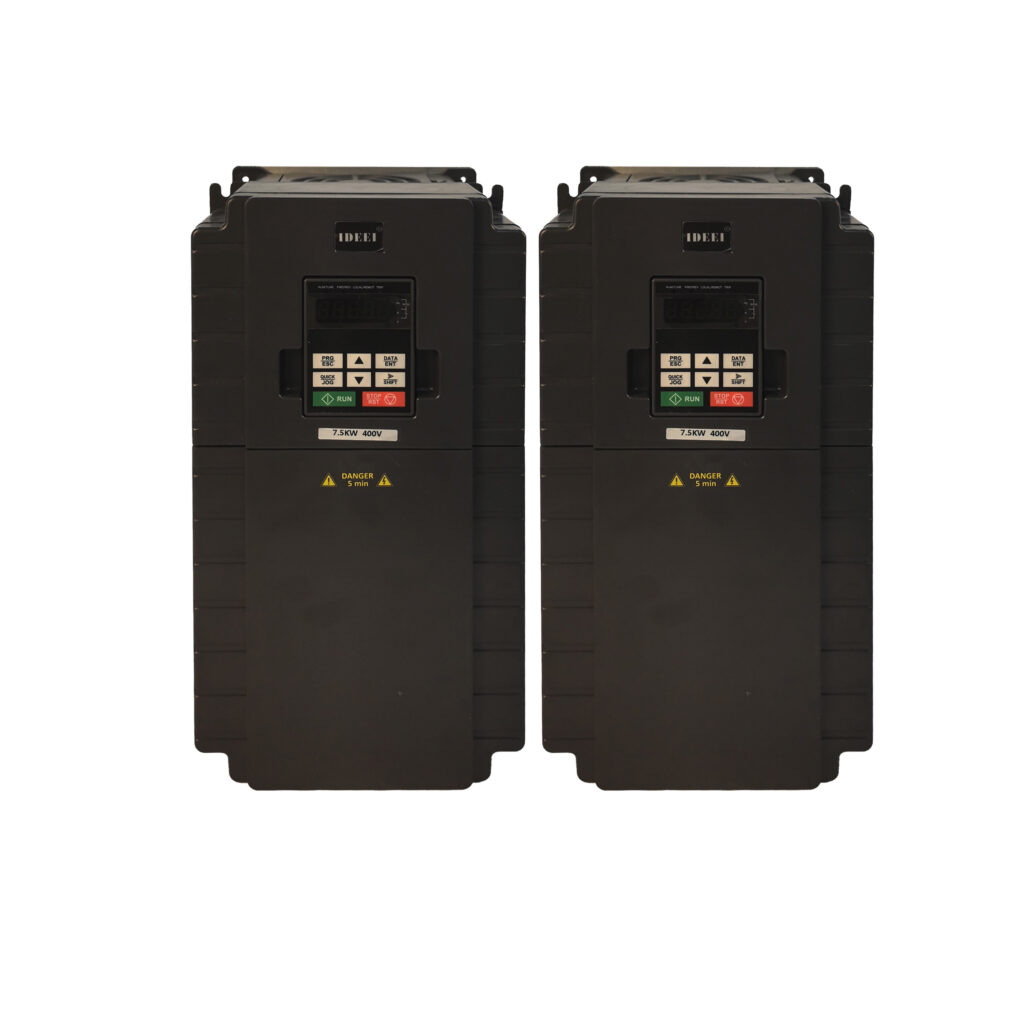
Both devices vary the frequency of the power feeding a three-phase motor, and on a nameplate they can look almost identical. The difference shows up the moment the power source is a solar array instead of the grid. A standard VFD is built around a stable supply: it expects the DC bus voltage to stay roughly constant and trips when it does not. An MPPT solar pump inverter is built around a supply that changes every minute, and it treats that variation as normal working conditions rather than a fault. This article explains where the two designs diverge, what MPPT actually does inside the drive, and when a standard VFD is still a reasonable choice.
What a standard VFD assumes about its power supply
A general-purpose VFD rectifies incoming AC into a DC bus, then inverts it back to variable-frequency AC for the motor. Its control logic assumes the bus is stiff: if input voltage falls, the drive protects itself with an undervoltage trip and stops. That behaviour is correct in a factory, where a voltage dip means something is wrong upstream. Feed the same drive from solar panels and the logic misfires all day long. Panel voltage sags under load, rises when clouds clear, and collapses at dawn and dusk. A drive that treats every sag as a fault will start late, stop early, and fault out repeatedly in passing cloud, delivering far less water than the array could have produced.
Installers sometimes work around this by feeding a standard VFD through its DC bus terminals, but the core problem remains: the drive has no idea where the array produces maximum power, so it cannot hold the pump at the best operating point as conditions change.
What MPPT changes inside the drive
MPPT (maximum power point tracking) continuously searches for the voltage and current combination at which the array delivers the most watts at that moment. The controller nudges the operating point, measures the result, and nudges again, many times per second. As irradiance rises, it lets the pump speed up; as a cloud passes, it slows the pump down to match the power actually available instead of stalling or tripping. The pump therefore starts earlier in the morning, keeps turning through broken cloud, and stops later in the evening. On the QB100-PV solar pump inverter, MPPT efficiency is rated up to 99%, and the wide DC input windows (180-450V DC on the 220V classes, 250-900V DC on the 400V three-phase class) let the same drive family cover pumps from 0.4kW to 37kW in plastic-shell models.
Because the drive is designed to run from a soft source, weak-sun behaviour is completely different. Rather than faulting, an MPPT solar pump inverter reduces frequency and keeps delivering whatever flow the light supports. For irrigation and livestock water, those extra low-flow hours at the start and end of the day add up to a significant share of daily volume.
Pump-specific protection a general VFD does not have
The second gap is protection logic. A standard VFD knows about current, voltage and temperature, but nothing about water. A solar pump inverter adds the protections a borehole or surface pump actually needs:
- Dry-run protection. When the well runs dry, motor load drops in a recognisable pattern. The drive detects the low-load condition and stops before the pump damages itself, then retries after a delay.
- Water-level control. Sensor inputs let the drive stop when the storage tank is full and restart when the level falls, with no separate controller.
- Automatic daily operation. The drive wakes with the sun, runs while power is available, and sleeps at night, which is what unattended sites need.
- Soft ramping. Controlled acceleration reduces water hammer and mechanical stress on long pipe runs.
The IDEEI S80 solar pump inverter (0.75-200kW) combines advanced MPPT with dry-run and water-level protection in the same unit, which is the typical feature set to compare against when a supplier offers a standard VFD as a cheaper substitute.
Side-by-side comparison
| Aspect | MPPT solar pump inverter | Standard VFD |
|---|---|---|
| Designed power source | PV array directly, wide DC window | Grid or generator AC, stable DC bus |
| Power tracking | MPPT, follows array maximum power point | None; fixed setpoint logic |
| Weak-sun behaviour | Slows down and keeps pumping | Undervoltage trips are common |
| Dry-run protection | Built in (low-load detection) | Not normally available |
| Tank level control | Sensor inputs built in | Needs external controller |
| Daily start/stop | Automatic with sunlight | Manual or timer based |
| Best use | Solar pumping, off-grid water | Grid-fed motors, factory duty |
When a standard VFD is still the right tool
None of this makes standard VFDs bad equipment. If the pump is fed from a reliable grid supply or a generator, if an existing drive is already installed and working, or if the motor runs other machinery as well as the pump, a standard VFD remains a sound, economical choice. Some hybrid sites also keep AC pumping for night-time demand. The mistake is not using a VFD; it is expecting VFD control logic to behave like solar control logic. Where AC backup is genuinely needed alongside solar, a hybrid solar pump inverter with automatic AC/DC switching solves both problems in one unit instead of forcing a compromise. For the borderline cases, see when to choose a regular VFD vs a solar pump inverter.
How to decide for a new solar pumping project
Use this checklist in order, and do not skip step 1: most wrong choices are made by starting from price or from a drive that is already on site.
- Identify the primary power source. If solar is the primary source and the pump must run unattended, specify a dedicated MPPT solar pump inverter. If the grid is primary and solar is only supplementary, a standard VFD or a hybrid model is back on the table.
- Match the array voltage window to the drive class. 220V-class drives such as the QB100-PV S2 and SS2 branches accept 180-450V DC, while the 400V three-phase branch accepts 250-900V DC for larger motors. A drive outside its window will trip or underperform, however good its MPPT is.
- Check that dry-run and tank-level functions are built in rather than added later with external controllers. Add-on protection is where unattended solar jobs usually fail.
- Decide whether AC backup is genuinely needed. If night-time or cloudy-day pumping is required, evaluate a hybrid model with automatic switching instead of forcing a standard VFD to behave like a solar drive.
- Confirm the motor rated current, phase and cable length with the supplier before ordering. A drive chosen on pump power alone can still be the wrong drive for the motor and the cable run.
Two related decisions are worth reading before ordering: can a standard VFD run on solar panels, and when to choose a regular VFD vs a solar pump inverter.
Frequently asked questions
Can I run my existing standard VFD from solar panels?
Sometimes, through the DC bus, but without MPPT the array is poorly utilised and undervoltage trips are frequent in changing light. It works as an experiment; it rarely works well as a permanent unattended installation.
Does MPPT really increase daily water output?
Yes, mainly by extending the pumping day. Tracking the maximum power point lets the pump start earlier, ride through cloud, and stop later, so the gain shows up as more hours of flow rather than a higher peak flow.
Is a solar pump inverter more expensive than a standard VFD?
The unit price is usually higher, but the comparison should include the external level controllers, protection relays and call-outs a bare VFD needs for the same unattended job. On a like-for-like system basis the gap narrows or disappears.
Can I buy the cheapest standard VFD now and add MPPT later?
No, and this is the trap. MPPT is not a bolt-on accessory; it is the drive’s control logic, built around a wide DC input window and soft-source behaviour. Adding a separate controller later does not turn a standard VFD into a solar pump inverter, and it leaves dry-run and tank-level protection still to be solved. If solar is the primary source, buy the MPPT drive first; if the budget only stretches to a standard VFD, the honest answer is to keep the pump on grid or generator power until the solar drive is affordable.
If my pump already has grid power, do I still need an MPPT drive for solar?
Only if solar will be a real operating source, not just a backup idea. For occasional solar assistance with dependable grid power, a standard VFD or a hybrid model may be enough. For daily unattended solar pumping, the MPPT drive is still the right tool, even where the grid exists, because it is the only option that follows the array through cloud and weak sun without repeated trips.
Can a standard VFD be given dry-run protection by an external relay?
Partly, but not to the same standard. An external relay can stop a pump on low current, yet it cannot reproduce the drive’s integrated low-load detection, retry timing and tank-level logic in one coordinated unit. For an attended site that trade-off may be acceptable; for an unattended borehole it is usually a false economy.
Tell us your pump rating, well depth and whether AC backup exists, and we will confirm whether an MPPT model or a hybrid fits your site: contact the IDEEI team.