
When you specify a drive for an elevator, one decision shapes everything else: open-loop or closed-loop control. Not the brand, not the kilowatt rating — the control architecture. It determines the levelling accuracy at the landing, the ride comfort your passengers feel, the wiring on site, and even what the drive costs once all the parts are counted. This guide compares the two honestly, maps them onto the IDEEI elevator drive families, and ends with the decision rules engineers actually use. For a building-by-building retrofit version of this decision, see our companion guide: Elevator Retrofit: Should You Choose Open-Loop or Closed-Loop?
What the “loop” actually means
The loop is the feedback loop between the motor and the drive. In an open-loop drive, the controller sends voltage and frequency commands to the motor based on a mathematical motor model — but it never checks what the motor actually did. It is driving with a map and no eyes on the road. In a closed-loop drive, an encoder mounted on the motor shaft reports the real speed and rotor position back to the drive, hundreds or thousands of times per second, and the drive corrects its output continuously. Map plus eyes.
That single difference cascades into everything: how precisely the car stops level with the landing, how much torque is available at crawling speed, how smooth the start feels, and how much work commissioning takes. Neither is universally better — they are different tools for different jobs.
Side-by-side comparison
| Aspect | Open-loop | Closed-loop |
|---|---|---|
| Feedback | No encoder feedback; control from motor model | Encoder on motor shaft feeds speed/position back in real time |
| Levelling accuracy | Good for most freight and low-rise duty; depends on model quality and load | Precise; the drive knows exactly where the rotor is and corrects drift |
| Low-speed torque | Adequate; limited at very low speed and standstill | Full torque available down to zero speed — holding torque at the landing |
| Ride comfort | Smooth when well tuned; start and stop ramps do the heavy lifting | Smoother starts and re-levelling under load changes |
| Wiring & commissioning | Simpler: motor cables, control signals, done | Plus encoder cabling, encoder alignment, and PG card setup — more steps, more skill |
| Total cost | Drive only | Drive + encoder + PG card (priced separately, see below) |
| Typical use | Freight lifts, low-rise residential, budget retrofits | Passenger lifts, high-rise, hospitals, anywhere levelling and comfort are specified |
Where the IDEEI families sit
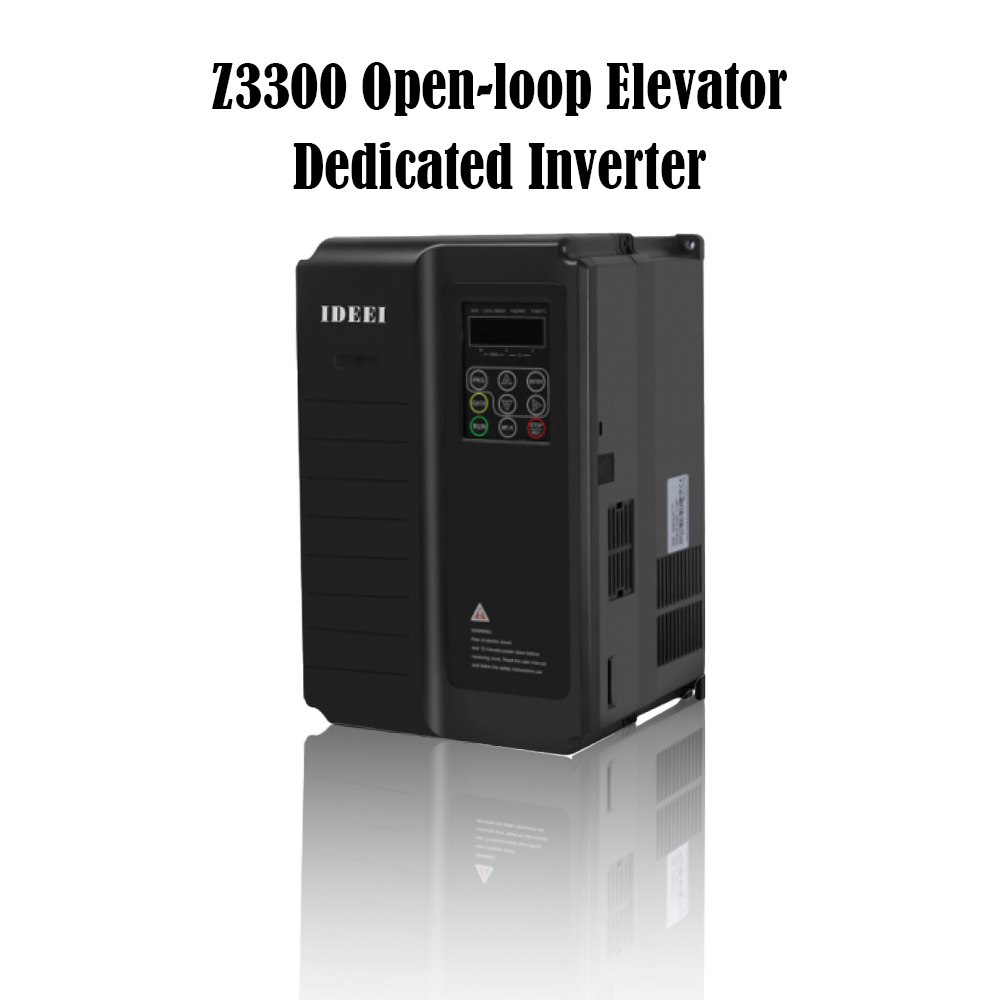
IDEEI covers both architectures, which is exactly why the choice is real rather than theoretical. The Z3300 (open-loop) and D3300 (closed-loop) elevator inverters share the same 2.2-45kW platform: the Z series runs open-loop for cost-sensitive duty, the D series adds encoder feedback for precision work. The Z3300-P and D3300-P series bring the same pairing to 2.2-37kW with 220V/380V supply classes and RS485 communication for modernization projects. And the 11LIFT closed-loop elevator inverter (2.2-37kW) supports both open-loop and closed-loop configurations, which makes it the flexible option when the final control mode is decided late in a project.
The 11LIFT published control figures show the gap in numbers: open-loop (SVC) starting torque of 180% at 0.5 Hz, a 1:100 speed ratio and ±0.5% speed stability, against closed-loop (FVC) starting torque of 200% at 0 Hz, a 1:1000 speed ratio and ±0.05% speed stability. If a building’s levelling tolerance is tighter than open-loop accuracy can guarantee, that table alone settles the choice.
The honest takeaway: if you already know you need closed-loop precision, buy the D series or the 11LIFT and budget the encoder hardware. If the application is a goods lift in a warehouse, the Z series open-loop will do the job at a lower total cost — and the money saved buys better doors, which passengers notice far more than control theory.
The PG card question (priced separately, not bundled)
Closed-loop control needs an encoder feedback interface — the PG card — between the encoder and the drive. On the 11LIFT closed-loop version, that card is required and priced separately: it is not bundled into the drive, and it is not optional. Any quotation that compares an open-loop drive with a closed-loop drive without adding the PG card understates the closed-loop cost.
The card must match the encoder type, so it is not a single interchangeable part. The variants include:
- 1387 Encoder Feedback
- ABZ Encoder
- MCTC-PG-E (SIN/COS, for synchronous motors)
- 1313 Absolute Encoder (Heidenhain ECN413)
- MCTC-PG-F1 (Absolute Encoder)
The true cost difference of going closed-loop on the drive side is therefore the PG card plus the encoder itself plus the extra commissioning — quoted for the specific encoder type, not guessed from a catalogue line. Confirm the correct card before ordering, and confirm who supplies and commissions it.
How to Choose for a Retrofit: Decision Steps
- State the building and the duty first: passenger or freight, floor count, traffic pattern and who uses the lift. Hospitals and accessible buildings start with a different requirement from warehouse goods lifts.
- Write the levelling requirement down before choosing a drive. If the car must level accurately under full and empty load and boarding must be step-free, closed-loop is the default; if tolerance is loose, open-loop is in play.
- Inspect the existing motor and encoder. Record the encoder type and condition — it determines which PG card the closed-loop option needs and whether encoder work is in scope.
- Check the existing drive against the modernization signals in Elevator Drive Modernization: 7 Signs Your Lift VFD Is Due for an Upgrade. A drive failing for other reasons should not be kept alive by a control-mode debate.
- Compare complete quotations, not bare drive prices: open-loop against closed-loop plus PG card plus encoder work plus commissioning, including encoder alignment and low-speed tuning.
- Decide and record the reason. For a building-by-building matrix — low-rise residential, goods lift and warehouse, high-rise commercial, hospital and accessible building — see our elevator retrofit guide.
Open-loop done well beats closed-loop done badly
A warning that experience teaches: control mode is not a substitute for commissioning. A well-tuned open-loop drive on a mechanically sound lift will ride better than a closed-loop drive with a misaligned encoder, noisy encoder cabling or untuned low-speed parameters. Whichever mode you choose, budget the commissioning time and the engineer who can do it — the cheapest drive with the worst tuning is the most expensive lift in the building.
A different question: should you modernize at all?
This article assumes you have already decided to replace or specify the drive and need to pick the control mode. If you are not sure the drive is the problem, start with the symptoms: repeated levelling faults, rough starts, nuisance trips and obsolete parts are covered in the seven signs your lift VFD is due for an upgrade. Fixing a brake, a guide or a controller fault will not be solved by changing loop type.
Frequently asked questions
Can an open-loop drive be upgraded to closed-loop later?
Only if the drive hardware supports a PG card option and you can fit an encoder to the motor. On a drive with no PG card slot, the upgrade is a drive replacement, not a software change — check the hardware before promising an upgrade path.
Does closed-loop automatically mean a better ride?
No — it means the potential for better levelling and low-speed torque. Realized comfort still depends on mechanical condition, encoder alignment, cabling and tuning. Closed-loop raises the ceiling; commissioning determines whether the lift reaches it.
Which PG card do I need?
Match the card to the motor’s encoder type: incremental ABZ encoders use the ABZ-type cards, SIN/COS encoders for synchronous motors use the MCTC-PG-E type, and absolute encoders use the 1313 or MCTC-PG-F1 types. If the encoder type is unknown, identify it before ordering — the wrong card is not a minor variation, it is a non-working feedback loop.
If the old motor already has an encoder, is closed-loop almost free?
No — this is the trap in many retrofit budgets. An existing encoder does not remove the PG card, which is still required and priced separately for the closed-loop drive, and it must match the encoder type. The encoder must also be checked for condition and alignment, and closed-loop commissioning and tuning are still required. An existing encoder saves the cost of fitting a new one; it does not make closed-loop free.
For a retrofit, how do I choose between open-loop and closed-loop?
Apply the decision steps above to the actual building: levelling requirement first, then motor and encoder condition, then complete quotations including the PG card and commissioning. Our retrofit guide works through the same choice by building type — low-rise residential, goods lift and warehouse, high-rise commercial, and hospital and accessible buildings — in Elevator Retrofit: Should You Choose Open-Loop or Closed-Loop?
Still weighing open-loop against closed-loop for a specific lift? Tell us the building type, the floor count, the existing motor and encoder details, and the levelling problem you are trying to solve. Contact IDEEI for drive advice.