
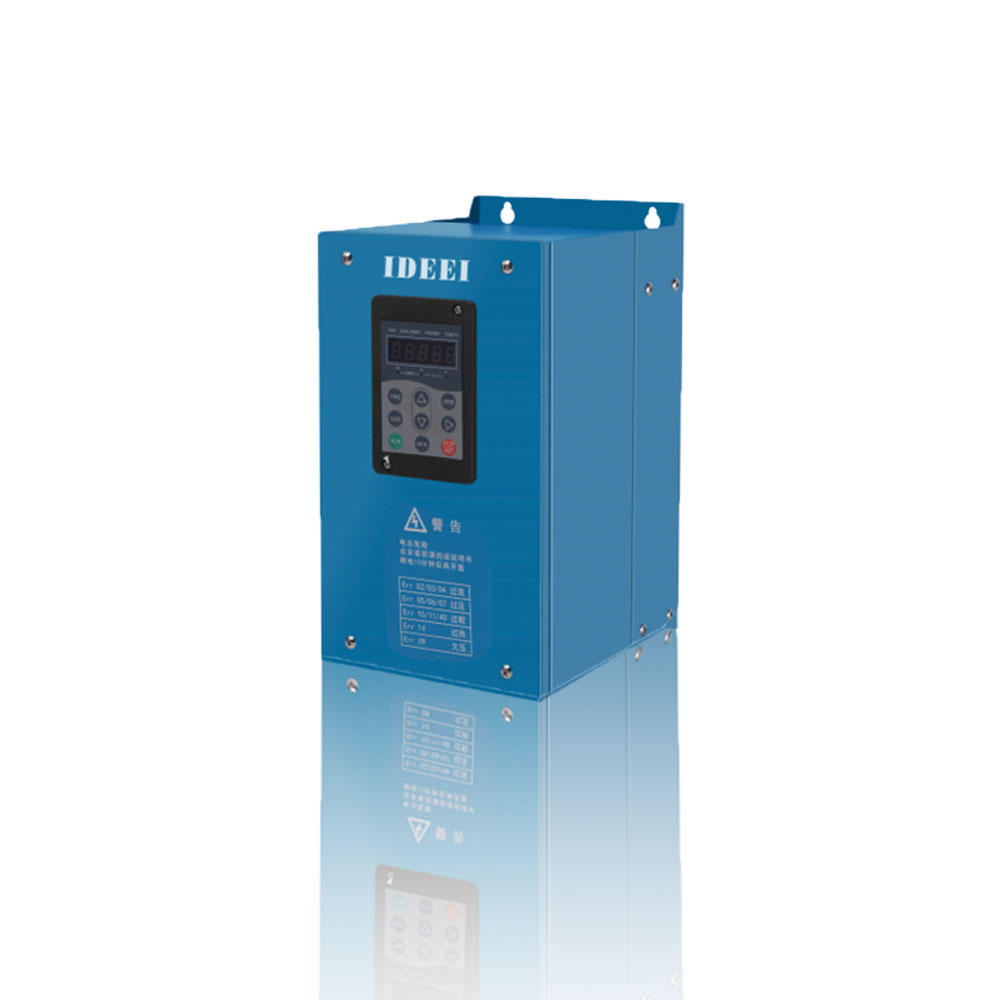
Most solar pump installations stand far from any building: at the edge of a field, next to a borehole, beside a pond or a village water point. Traditionally, the inverter that controls the pump had to live inside a separate control cabinet — a weatherproof box that adds cost, takes up space, needs its own ventilation, and becomes one more item to buy, ship, install, and maintain. For a single-pump system, the cabinet is often the most annoying line on the bill of materials.
This is where an IP65-rated solar pump inverter changes the equation. With a dust-tight, water-jet-resistant enclosure, the drive itself can be mounted outdoors — on a wall, a pole, or a pump-house structure — with no separate control cabinet at all. The IDEEI IP65 solar pumping VFD, covering 0.4-37kW with MPPT, is built exactly for this job: a drive that takes the weather so your system does not need a box around it.
But IP65 is also one of the most misunderstood labels in the industry. It does not mean the inverter can be submerged, it does not make installation trivial, and it does not forgive sloppy wiring. This guide explains what the rating really covers, how cabinet-free outdoor installation should be done, and where its limits are — so you can decide whether it fits your project.
What the IP65 rating actually covers
The IP code comes from the IEC 60529 standard, and its two digits say two different things. The first digit, 6, is the solids rating: the enclosure is dust-tight, meaning no ingress of dust that could foul contacts, clog heatsink fins from the inside, or creep into terminal chambers. The second digit, 5, is the liquids rating: the enclosure is protected against water jets projected from any direction — the test uses nozzles aimed at the unit from all sides.
In practice, that means an IP65 drive survives rain, dust storms, irrigation spray, and the occasional hose-down during cleaning. What it does not mean is equally important:
- Not submersible. Protection against immersion is what IP67 and IP68 are for. An IP65 unit mounted where flood water can reach it is a failure waiting to happen.
- Not condensation-proof. Temperature cycling can pull moist air inside through breathing; the rating describes the enclosure, not the climate inside it.
- Not corrosion-proof by default. Salt spray near the coast attacks hardware, hinges, and heatsink coatings unless the unit is specified for it.
- Not maintenance-free forever. Gaskets and seals age under UV and heat. A five-year-old gasket is not the same seal that left the factory.
Honest framing matters here: IP65 describes a well-sealed box, not an indestructible one. Install it with that understanding and it will serve for years; treat the label as magic and the weak points — usually cable entries and sun-baked seals — will find you.
IP65 vs the cabinet approach
Most pump inverters on the market are built for cabinet installation. Take the QB100-PV solar pump inverter: its plastic-shell models are designed to go inside an enclosure, with an IP54 cabinet offered as an option for the assembly. The cabinet is where the protection rating lives in that architecture — the drive inside can stay a standard indoor unit.
An IP65 drive inverts that logic: the protection moves into the drive itself. The comparison below is deliberately simplified, but it captures how projects usually decide:
| Aspect | Cabinet-based installation | IP65 drive, no cabinet |
|---|---|---|
| Upfront cost | Drive + cabinet + cabinet ventilation/fans | Drive only; usually cheaper for single-pump systems |
| Footprint | Cabinet floor/wall space required | Drive mounts directly on wall or pole |
| Heat path | Cabinet must be ventilated or cooled as a whole | Heatsink exposed to free air; shade still recommended |
| Service access | Everything in one room: contactors, meters, breakers | Drive only; auxiliaries need their own small boxes |
| Failure points | Cabinet seals, fans, filters, hinges | Drive gaskets and cable glands — fewer, but critical |
| Best fit | Multi-pump stations, control rooms, harsh industrial sites | Single outdoor pumps: fields, wells, farms, villages |
Neither approach wins everywhere. A pumping station with three pumps, flow meters, and a PLC still belongs in a proper cabinet. A single 5.5kW borehole pump at the corner of a field usually does not — that is the IP65 sweet spot.
Where cabinet-free installation makes sense
- Agricultural irrigation — drip and sprinkler blocks where the pump sits at the field edge and the nearest building is a kilometer away.
- Livestock water points — troughs and tanks in pastures, where a cabinet would be vandal-prone clutter.
- Remote wells — boreholes with a solar array and nothing else; the drive bolts to the array structure or a pole.
- Village water supply — small kiosk-style installations where simplicity is a feature, not a compromise.
- Fish farms and greenhouses — humid environments where an extra steel cabinet just adds another surface to corrode.
And where it does not make sense: inside flood plains where water can stand above the unit, marine splash zones without additional coating, or sites that need a dozen auxiliary devices — contactors, timers, meters — in one place. Be honest about the site and the choice makes itself.
Outdoor mounting rules that actually matter
Skipping the cabinet does not mean skipping installation discipline. These are the rules that separate a ten-year installation from a two-year one:
- Solid support. Wall or galvanized pole, rigid and plumb. A drive that vibrates in the wind works its fixings — and its seals — loose.
- Orientation. Heatsink fins vertical so natural convection works; cable entries and glands facing down so water cannot track along cables into the enclosure.
- Shade. A simple sunshade or roof overhang is the cheapest reliability upgrade available. Direct sun on a dark enclosure can add 20-30C to the internal temperature — heat, not water, is what kills most outdoor electronics.
- Airflow clearance. Leave the clearances the manual specifies around the heatsink. Never box the drive in tightly “for extra protection” — you would be building the oven you were trying to avoid.
- Mounting height. Above the local maximum flood level and above the reach of irrigation sprinklers. Check where water actually goes in the worst storm, not the average one.
- Cable glands done right. Match gland size to cable diameter, tighten to spec, and seal every unused entry with a proper blanking plug. In field failures of “IP65” equipment, the cable gland is the weak point far more often than the lid gasket.
- Grounding. A solid earth connection is non-negotiable outdoors, where lightning exposure is higher. Grounding and surge protection matter more without a cabinet, not less.
Heat: the silent derate
Here is the physics no rating label can repeal: an IP65 enclosure cannot breathe the way an open-frame drive can. It relies on its heatsink — and sometimes an internal fan — to move heat out through sealed walls. Electronics age faster when hot; as a rough industry rule of thumb, every 10C of sustained extra temperature roughly halves the life of typical electrolytic capacitors. The rating keeps water out; it does nothing about heat.
Three practical consequences follow. First, shade is not optional in hot climates — it is part of the thermal design. Second, if full sun is genuinely unavoidable, size with margin: running a drive below its nameplate current during the hottest hours is the same 25% headroom logic used when sizing pump inverters generally. Third, keep the heatsink fins clean — dust, cobwebs, and insect nests on the fins quietly undo the whole thermal design, and nobody notices until the first thermal trip of summer.
Check the manual’s ambient temperature limits and take them literally. An IP65 drive rated for a given ambient assumes free air around it; a unit baking inside a closed metal box “for protection” is operating outside its design envelope.
What “no cabinet” does not excuse
A cabinet-free installation is simpler, not protection-free. The protections a cabinet would have housed still need to exist, just in smaller, distributed form:
- A DC disconnect or breaker between the PV array and the drive, rated for the array voltage and current.
- Appropriate fusing on DC and AC sides, sized to the actual conductors.
- Surge protective devices on the DC side — and on the AC side where grid or generator backup connects — because an outdoor drive is the tallest lightning target in the system.
- Correctly sized solar and motor cables; voltage drop over long cable runs to a remote pump is a real performance thief.
- IP65-rated junction boxes for any external terminations, so the system’s weakest link is not the box you added beside a sealed drive.
- Clear labeling and a safe maintenance access path — the next technician will thank you.
Matching the drive to the pump
The IDEEI IP65 solar pumping VFD covers 0.4-37kW with MPPT, which maps neatly onto the mainstream range of submersible and surface pumps used in agriculture and village water supply — from small domestic borehole pumps up to serious irrigation sets. Array sizing follows the same rules as any solar pumping system: size the PV array at roughly 1.3 to 1.6 times the motor power, and give the inverter about 25% headroom above the motor rating.
For stations above that range — 45kW and up — the right family is the cabinet-based iron-shell line, such as the QB100-PV 45-280kW models, installed in a proper enclosure or electrical room. Matching the enclosure concept to the power class is part of honest system design, and it is exactly the conversation to have before ordering hardware.
Frequently asked questions
Can an IP65 inverter be left out in heavy rain?
Yes — that is precisely what the rating is for. What it cannot do is sit in standing water or survive submersion, so mount it above the flood level and keep cable entries facing down.
Do I still need a sunshade if the drive is IP65?
Strongly recommended. The rating covers water and dust, not heat. A simple shade can cut internal temperatures dramatically and is the cheapest way to extend the drive’s life in hot climates.
How often should seals and cable glands be inspected?
At least once a year — more often in dusty, salty, or high-UV environments. Check gaskets for cracks and compression set, verify glands are still tight, and replace any hardened seal before it becomes a leak path.
If your project is a pump at the edge of a field with no building nearby, send us the pump power, the site conditions, and how the water is used through our contact page — we will confirm whether the IP65 0.4-37kW drive is the right fit or a cabinet-based unit is the safer choice.
How to Install an IP65 Solar Pump Inverter Outdoors, Step by Step
Follow the mounting rules above in order, and confirm the drive size before you drill anything: the sizing guide uses about 25% headroom above the motor rating and a PV array of roughly 1.3 to 1.6 times the motor power.
- Confirm the site. Choose a spot above the local maximum flood level and above the reach of irrigation sprinklers, with safe maintenance access.
- Fix a solid support. Mount on a rigid, plumb wall or galvanized pole so wind vibration cannot work fixings and seals loose.
- Set the orientation. Keep heatsink fins vertical for natural convection, with cable entries and glands facing down.
- Add shade and clearance. Fit a sunshade or use a roof overhang, and leave the manual’s clearances around the heatsink; never box the drive in tightly.
- Terminate cables correctly. Match each gland to its cable diameter, tighten to spec, and seal every unused entry with a proper blanking plug.
- Complete the protection. Fit the DC disconnect or breaker, DC and AC fusing, surge protection, correctly sized cables and IP65-rated junction boxes, then make a solid earth connection.
- Check before running. Inspect gaskets and glands, clear the heatsink fins, and confirm labeling and access before first start-up.
Daytime pumping does not need a battery: store water, not electricity. Only add a battery when you have night loads, critical loads that must survive an outage, or loads that must ride through cloud dips — see how to size battery capacity in kWh.
More frequently asked questions
Can an IP65 inverter be submerged or buried?
No. IP65 covers dust and water jets, not immersion. Immersion protection is IP67 and IP68, so a drive that may stand in water is in the wrong place however good its seals look.
Should I size the drive before I mount it outdoors?
Yes. Mounting first and sizing later risks a drive that trips or derates in heat. Use the sizing guide first: about 25% headroom above the motor rating, with a PV array of roughly 1.3 to 1.6 times the motor power.
Does an outdoor IP65 pump inverter need a battery?
Not for daytime pumping, where the tank is the storage. Add a battery only for night loads, outage-critical loads, or loads that must stay stable through cloud dips, as explained in the battery capacity guide.