
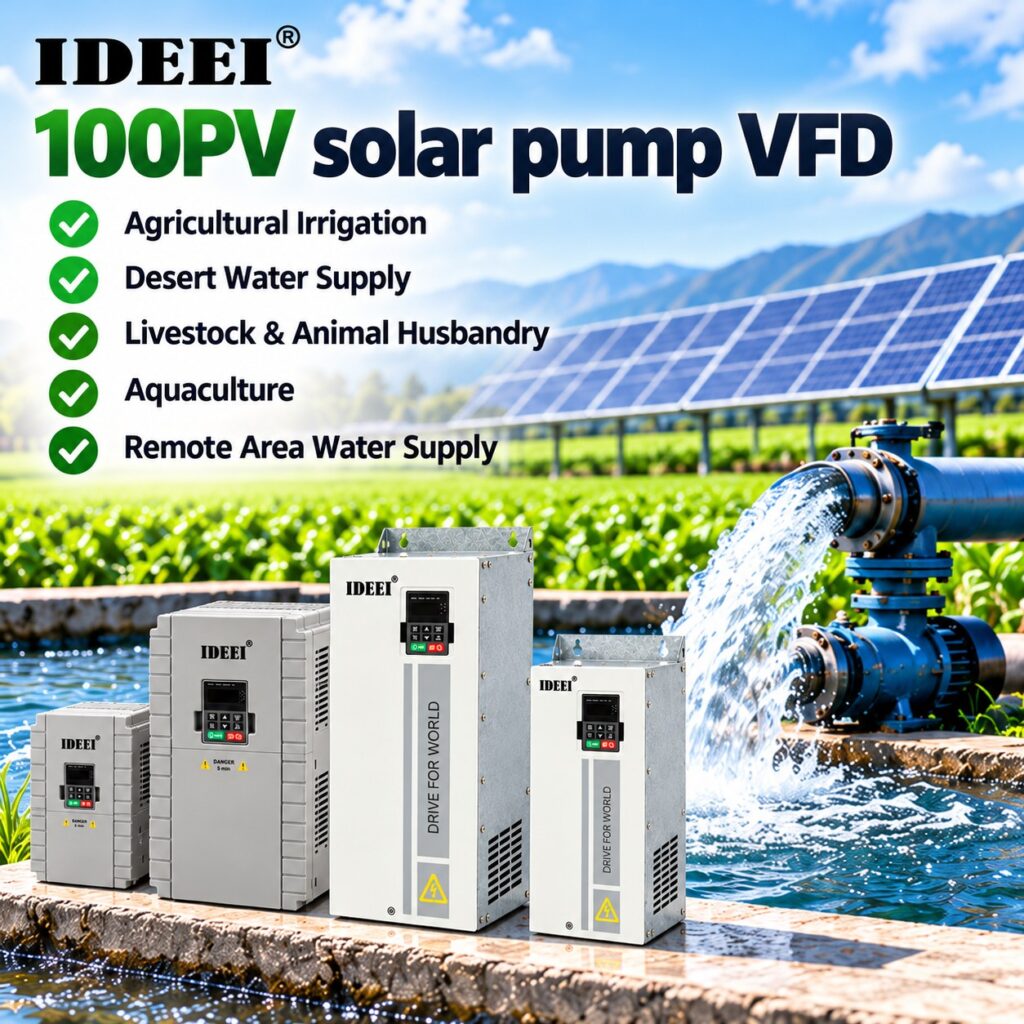
“What size solar pump inverter do I need?” is the first question in almost every solar pumping project, and it is the question that decides whether the system runs for a decade or trips every afternoon. Oversize the drive and you pay for capacity you never use. Undersize it and the pump stalls at start-up, overheats the motor, or shuts down whenever a cloud passes. This guide walks through the sizing method professional installers use: start from the pump motor, apply a realistic safety margin, then size the solar array to feed the inverter. A complete HP/kW table below maps common pump sizes to the IDEEI QB100-PV ranges.
Start With the Pump Motor, Not the Panels
Every sizing exercise begins with the motor nameplate. Three values matter: rated power (in kW or HP), rated voltage, and phase. The inverter must be rated for the motor’s voltage and phase first, and for its power second. A 380V three-phase borehole pump cannot be driven by a 220V single-phase inverter, no matter how generous the kilowatt rating looks on paper.
If the nameplate is worn or missing, work from the pump’s rated current instead. As a rule of thumb, a solar water pump inverter should be rated at least equal to the motor’s full-load current, and preferably one size above it. Current, not headline power, is what the inverter’s output stage actually has to deliver on a hot afternoon with a long cable run.
The 25% Rule: Surge Current and Real-World Derating
Why do experienced installers rarely match inverter and motor one-to-one? Because a pump motor is not a resistive load. At start-up it can draw several times its rated current for a short burst, and even a VFD-controlled soft start needs headroom to accelerate a water-filled rising main. Add three more real-world factors:
- Heat: inverter output capacity falls as ambient temperature rises, and pump houses in irrigation regions routinely exceed 40°C.
- Cable length: deep boreholes mean long motor cables, voltage drop, and extra current to deliver the same shaft power.
- Ageing: a pump that is five years old draws more current than its nameplate suggests.
The standard working rule is to choose a solar pump inverter roughly 25% above the motor’s rated power — in practice, simply pick the next inverter size up from the motor rating. The modest extra cost buys reliable starting, cooler operation, and room for the array to be expanded later. For a deep well, where head and cable length stack together, see How Do I Size a Deep-Well Pump for a Solar Pump Inverter?.
HP/kW Sizing Table: Matching the Pump to the QB100-PV Range
The table below converts common pump sizes (1 HP ≈ 0.75 kW) and maps them to the IDEEI QB100-PV series. The QB100-PV covers 220V pumps with S2 and SS2 branches and 400V three-phase pumps with 1.5–37 kW and 45–280 kW ranges.
| Pump size (HP) | Motor power (kW) | Recommended inverter rating | QB100-PV range | Typical application |
|---|---|---|---|---|
| 1 HP | 0.75 kW | 0.75–1.5 kW | S2 (220V) | Domestic wells, garden irrigation |
| 2 HP | 1.5 kW | 1.5–2.2 kW | S2 / SS2 (220V) | Small farm, livestock watering |
| 3 HP | 2.2 kW | 2.2–4 kW | S2 / SS2 (220V) | Smallholder irrigation |
| 5 HP | 3.7 kW | 4–5.5 kW | S2 / SS2 (220V) | Medium farm plots |
| 7.5 HP | 5.5 kW | 5.5–7.5 kW | 1.5–37 kW (400V) | Three-phase boreholes |
| 10 HP | 7.5 kW | 7.5–11 kW | 1.5–37 kW (400V) | Commercial irrigation |
| 20 HP | 15 kW | 15–18.5 kW | 1.5–37 kW (400V) | Large plots, water supply |
| 30 HP | 22 kW | 22–30 kW | 1.5–37 kW (400V) | Estates, municipal wells |
| 50 HP | 37 kW | 37–45 kW | 45–280 kW (400V) | Industrial / utility pumping |
| 100 HP | 75 kW | 75–90 kW | 45–280 kW (400V) | Large-scale irrigation schemes |
Browse the ranges here: QB100-PV solar pump inverter (0.4–37kW). For projects that also need a general solar pump inverter with MPPT in a wider three-phase frame, the S80 series is worth comparing.
How to Size a Solar Pump Inverter in Six Steps
- Record the motor nameplate. Note rated power in kW or HP, voltage, phase and full-load current. If HP is given, convert with kW = HP × 0.746.
- Apply the margin. Multiply motor kW by 1.25, or simply pick the next catalogue size up. Use the high end of the 10–30% band for deep wells, long cables, hot sites and older pumps.
- Match voltage and phase first. Confirm the inverter output class matches the motor exactly; a kW match on the wrong voltage or phase is not a match.
- Check output current, not only kW. Confirm the inverter output current covers the motor full-load current after the margin, especially on long cable runs.
- Size the array at 1.3 to 1.6 times motor power. Then check the string voltage against the inverter PV input class: DC 180–450V for 220V QB100-PV models and DC 250–900V for 400V models. For the series-count method, see How Many Solar Panels Do I Need for a Solar Water Pump?.
- Re-check head, flow and protections. Confirm the pump curve delivers the required flow at the total dynamic head, and that dry-run and overvoltage protection are stated for the model quoted.
Sizing the Solar Array for Your Solar Pump Inverter
An inverter can only deliver what the array feeds it. Because panels rarely produce their laboratory watts in the field, an array of about 1.3 to 1.6 times the motor power keeps the pump running at useful speed through the middle of the day and extends pumping hours in the morning and afternoon.
String configuration matters as much as total watts. The array’s open-circuit voltage must stay inside the inverter PV input class, and the working voltage must stay above its floor in weak light. A string outside the window will not run, however many watts it has.
220V Single-Phase or 400V Three-Phase?
Below roughly 5.5 kW, 220V single-phase systems dominate: panels, cabling and protection are simpler and the pump classes are well covered by S2 and SS2 branches. Above that, three-phase 400V systems take over for boreholes and larger irrigation, with QB100-PV models from 1.5 to 37 kW and an iron-shell platform from 45 to 280 kW for larger work.
Frequently Asked Questions
Can I use a much bigger solar pump inverter than my pump needs?
One size up is good practice; several sizes up is not. A heavily oversized inverter costs more, can make low-speed control and dry-run detection less accurate, and buys no extra water from a pump already at its curve limit.
How many solar panels do I need for a 3 HP pump?
A 3 HP (2.2 kW) motor typically pairs with a 2.2–4 kW inverter and an array of about 3–3.5 kWp. With a typical module, check the series count against the inverter voltage window before counting total panels.
What happens if the array is undersized for the inverter?
The system will still work, but the pump will start later, stop earlier, and deliver less water at peak demand, because the motor cannot reach useful speed for long enough each day.
Can a bigger array fix an undersized inverter?
No. This is the trap in sizing. More array watts cannot raise the inverter output current above its rating or change the motor rating. Fix the inverter size first, then size the array to the corrected system.
Do I size by kW or by current?
By both, with current as the final check. kW selects the catalogue step; full-load current, after the margin, confirms the output stage can actually deliver it on a hot day over a long cable.
What if my pump nameplate is missing?
Work from rated current and pump supplier data, and confirm voltage and phase from the installation wiring and the old drive, if any. Do not finalise a model from HP alone when current, head and flow are still unknown.
Not sure which size fits your well? Send IDEEI your pump nameplate data — motor power, voltage, phase, well depth and daily water target — and our engineers will confirm the model. Contact IDEEI for a sizing recommendation.