
Every variable frequency drive, whatever the brand, speaks roughly the same fault language — and learning that language turns a dead machine room or a silent pump house from a crisis into a checklist. This guide covers VFD troubleshooting for general industrial drives and elevator drives: the code families you will actually meet (overcurrent, overvoltage, undervoltage, overload, overheat and ground fault), what each one is really telling you, and the step-by-step sequence that separates a wiring problem from a dying motor. One boundary first: code labels vary by model and manufacturer — OC on one drive may be numbered or worded differently on another, so treat this guide as the map and your drive’s manual as the street names. Solar pumping drives have their own application layer on top of these basics; for dry-run and water-level trips specifically, see our companion guide to solar pump inverter fault codes and dry-run protection.
Before you touch anything: safety and the fault log
Two rules before any troubleshooting. First, safety: a VFD’s DC bus capacitors hold a dangerous charge for minutes after isolation, so observe the discharge wait time in the manual before opening terminals, and never megger-test a motor with the drive still connected — the test voltage destroys output stages. Second, evidence: do not reset the fault and hope. Record the exact code, the time, what the machine was doing (starting, running at speed, decelerating, holding a lift at floor), and the drive’s logged values — output current, DC bus voltage and frequency at the trip. Most modern drives keep a fault history; that history, not the blinking display, is where troubleshooting starts. A fault that appears only under load, only on hot afternoons, or only on one lift of a bank is telling you its cause before you pick up a meter.
Fault code table: code, likely cause, action
| Code | Likely cause | Action |
|---|---|---|
| OC — Overcurrent | Short or damaged motor cable, motor insulation failure, jammed load, or an acceleration ramp too short for the load. | Check cable and insulation, free the load, and lengthen the ramp only after a short or jam is ruled out. |
| OV — Overvoltage | DC bus voltage too high, usually regenerative energy during deceleration, or supply voltage too high. | Lengthen the deceleration ramp, check braking resistor and chopper where fitted, and check supply voltage. |
| UV — Undervoltage | DC bus or supply voltage too low: loose terminals, a dropped phase, weak supply, or dips when other loads start. | Check supply terminals and phases, and measure supply at the drive during the trip window, not at idle. |
| OL — Overload | Sustained current above the motor’s thermal model: mechanical drag, wrong motor data, or a load too big for the motor. | Check for drag, verify nameplate parameters, and confirm the motor is sized for the load. |
| OH — Overheat | Drive heatsink or motor temperature too high: blocked airflow, failed fan, dust-clogged filters, high ambient temperature, or poor motor cooling at low speed. | Clear airflow and filters, check the fan, and log heatsink temperature during the trip window. |
| GF — Ground fault | Current leaking from output to earth: damaged cable insulation, moisture in the motor terminal box, or water ingress in conduit. | Isolate and inspect cable insulation, terminal box and conduit for moisture and damage. |
How to troubleshoot a VFD fault in six steps
- Read and record. Note the code and the fault log values before resetting anything.
- Separate drive from load. Where the manual allows, run the drive with the motor disconnected at low frequency. A fault that persists with no motor connected points inside the drive; a fault that disappears points downstream.
- Inspect the cabling. Motor cables take the abuse: check terminals for looseness and heat discolouration, chafed insulation at glands, and water in junction boxes. A surprising share of OC and GF trips end here.
- Test the motor. With the drive isolated, measure winding resistance balance between phases and insulation resistance to earth. Unbalanced windings or low insulation condemns the motor, not the drive.
- Verify parameters. Motor nameplate data — power, voltage, current, speed — must match the drive’s motor parameters. A drive protecting a 7.5kW motor with parameters copied from a 15kW neighbour will nuisance-trip or under-protect.
- Watch a live run. Reconnect, run, and observe current and DC bus voltage through a start, a full-speed run and a stop. Note exactly which phase of operation trips — that timing is the diagnosis.
Trip timing table: when it trips is the diagnosis
| When it trips | What it usually means | Next check |
|---|---|---|
| At the instant of starting | Short circuit, ground fault, seized load, or a brake that never released | Cable, insulation, load freedom and brake timing |
| During acceleration | Ramp too short for load inertia, if the motor itself is healthy | Lengthen the ramp and re-test |
| At steady speed | Load changing: failing bearing, debris, rubbing guides or a changing process load | Mechanical inspection and live current logging |
| On deceleration | Regenerative energy raising the DC bus faster than it can be absorbed | Deceleration ramp, braking resistor and chopper |
| Only on hot afternoons | Heat narrowing every margin: derating, falling insulation resistance and sagging supply | Airflow, filters, fan and DC bus during the trip window |
Overcurrent: the trip you will meet most
OC trips split cleanly by timing. OC at the instant of starting suggests a short circuit, a ground fault on one phase, or a motor that cannot move — a seized pump, a jammed gearbox, a brake that never released. OC during acceleration with a healthy motor usually means the ramp is too short for the load’s inertia; lengthen it before suspecting hardware. OC at steady speed points at the load changing — a bearing failing, debris in a pump, a lift car rubbing its guides. OC is the drive defending its output stage in microseconds; resetting it repeatedly into an uncleared short is how a repairable trip becomes a destroyed drive. Find the cause after the second identical trip, not the tenth.
Undervoltage and overvoltage: reading the DC bus
The DC bus is the drive’s diary. UV trips cluster around supply events: a contactor with burnt tips, one fuse of three blown, a generator or weak grid sagging when a large load starts, or — on solar-fed systems — the array voltage collapsing under a cloud edge faster than the control can react. Measure the supply at the drive terminals during the trip window, not at a convenient idle moment. OV is the mirror image: the motor, acting as a generator while decelerating a heavy or overhauling load, pumps energy back faster than the bus can absorb it. The cures are longer deceleration ramps, a correctly sized braking resistor and chopper where the application needs fast stops — elevator duty being the classic case — and checking that nobody shortened the ramp to make the machine feel snappier.
Elevator drives: where troubleshooting gets specific
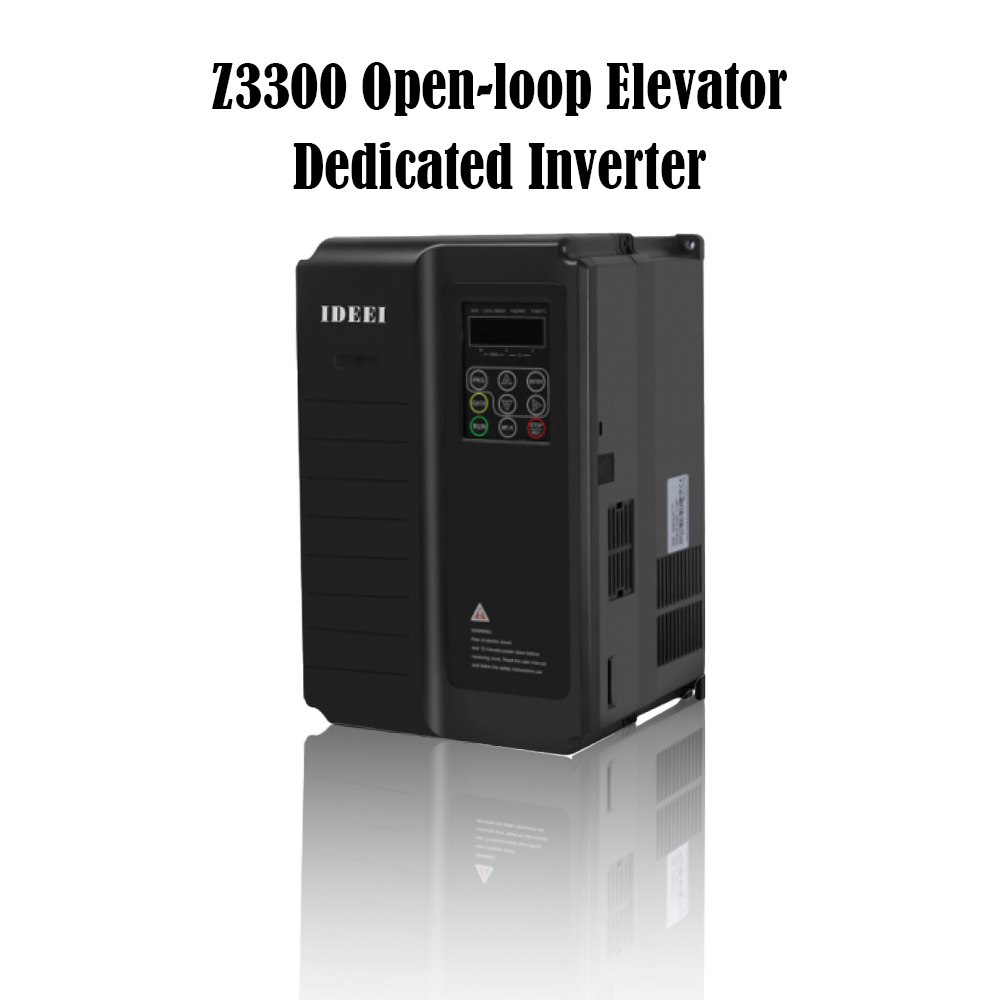
Elevator drives add two layers to the general picture: the brake and the encoder. A large share of elevator OC and overload trips trace to brake timing — a brake that opens late or drags loads the motor hard at start and stop. On closed-loop systems, encoder problems produce their own signature: unstable low-speed control, rollback at start, or trips that vanish in open-loop emergency mode. The IDEEI Z3300 (open-loop) and D3300 (closed-loop) elevator drive range (2.2–45kW) illustrates the practical divide: open-loop Z models cover machine-room and modernisation work without encoder wiring, while closed-loop D models add a PG encoder card for precise levelling. The 11LIFT elevator drive (2.2–37kW) likewise runs open or closed loop with an optional PG card. RS485 communication on these drives also means many faults can be read and logged remotely instead of from a ladder in the shaft.
For choosing between drive types, see MPPT Solar Pump Inverter vs Standard VFD: What Is the Difference? and When Is a Regular VFD Still the Right Choice Over a Solar Pump Inverter?. For a general-purpose example, see the IDEEI 3030 General Purpose Inverter (0.75-160kW, 230V and 400V).
When to stop and call support
Escalate rather than experiment when: the same fault returns immediately after a verified-good motor and cable test; you find physical damage, a burnt smell or discoloured boards inside the drive; the fault involves safety circuits on an elevator (brake, door locks, overspeed devices), where regulations — not convenience — govern what may be adjusted; or the drive is under warranty, where opening it may void the cover. Send support the full fault log, the parameter file if you can read it out, and the motor nameplate photo. That package gets you a diagnosis in one exchange instead of five.
Frequently Asked Questions
Can I just reset a VFD fault and keep running?
Once, while you watch what happens — not as a routine. A fault is the drive reporting a condition outside its safe envelope. Repeated resets into an uncleared overcurrent or ground fault convert a protection event into hardware damage.
Why does my drive trip only on hot afternoons?
Heat narrows every margin: the drive derates as its heatsink temperature climbs, motor insulation resistance falls, and supply voltage often sags with neighbourhood load. Check airflow, filters and fan operation first, then log the DC bus during the trip window.
Are fault codes the same across brands?
The families are, the labels are not. OC, OV, UV, OL, OH and GF concepts exist on virtually every drive, but the exact code text or number is manufacturer- and model-specific. Always confirm against the manual for the drive in front of you.
Can I just lengthen the ramp to fix every overcurrent trip?
No, and this is the trap. A longer ramp helps only when the cause is inertia and a healthy motor. If the cause is a short, a ground fault, a seized load or a dragging brake, lengthening the ramp hides nothing and repeated resets can destroy the drive. Rule out the fault first, then adjust the ramp.
Why does my drive trip only when it decelerates?
Deceleration trips are usually overvoltage: the motor acts as a generator and pumps energy back into the DC bus faster than it can be absorbed. Check the deceleration ramp and, where the application needs fast stops, the braking resistor and chopper.
Can I megger-test the motor while it is still connected to the drive?
No. Never megger-test a motor with the drive still connected — the test voltage destroys output stages. Isolate the motor from the drive first, and observe the DC bus discharge wait time in the manual before opening terminals.
Dealing with a drive that keeps tripping, or specifying drives for a lift modernisation? Send IDEEI the fault log and motor data — our engineers support the Z3300, D3300 and 11LIFT ranges directly.