
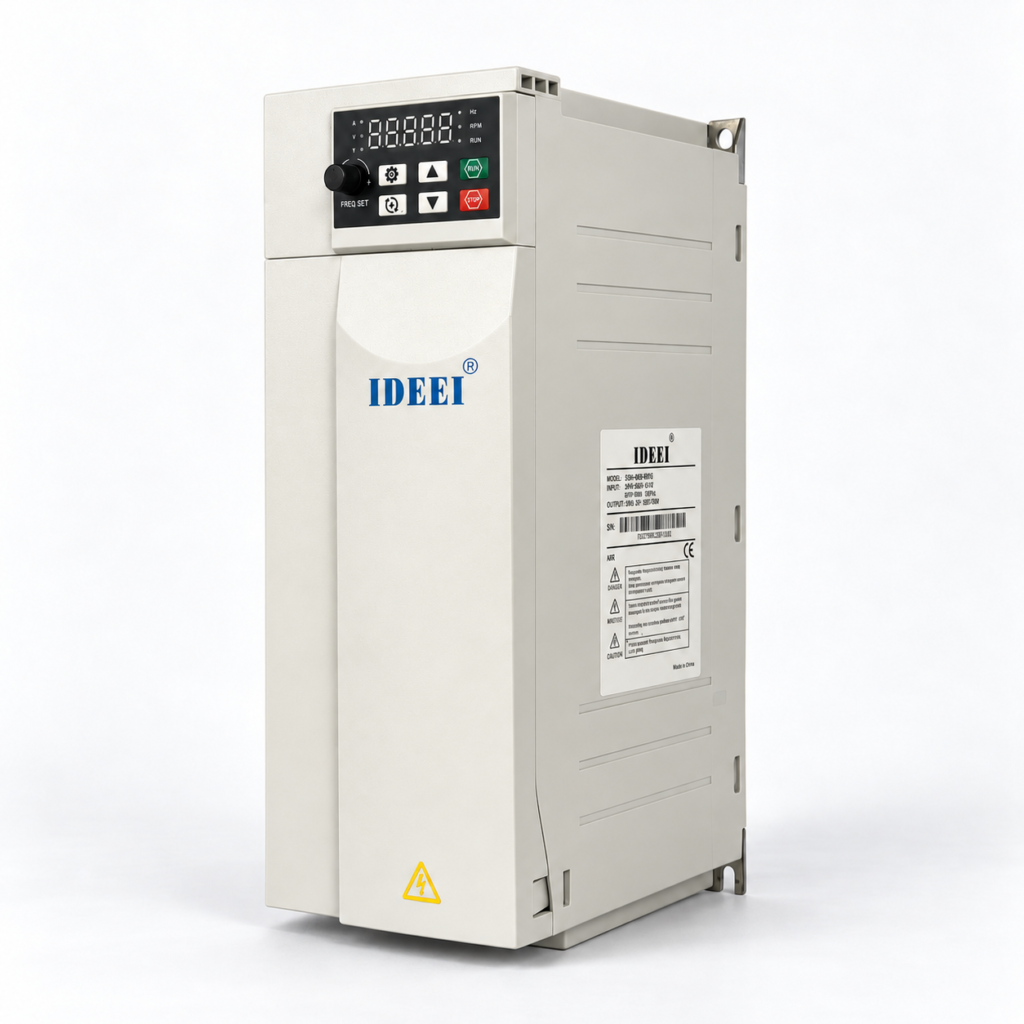
A solar pump inverter that only works when the sun shines is honest – but sometimes honesty is not enough. On farms where animals need water at dawn and in greenhouses that must stay humid through a cloudy week, an interrupted supply is a failed supply. That is the problem a hybrid solar pump inverter is built to solve. Instead of a single energy input, it accepts two: the PV array and the AC grid or a generator. When sunlight is strong, the pump runs on free solar power; when clouds pass or night falls, the drive automatically hands the load over to AC backup – with no manual changeover and no restart. The IDEEI S81, a hybrid solar pump inverter covering 0.75 to 200kW, is designed around exactly this behavior. This article explains how AC/DC auto switching works inside a hybrid drive, when it matters most, and how the S81 is positioned differently from its stablemate, the S80.
Two power inputs, one pumping job
A conventional solar pump inverter has one energy door: the DC bus fed by the PV array. A hybrid drive adds a second door – an AC input from the grid or a generator – and puts an automatic selector between them. In the S81 range of 0.75 to 200kW, that architecture scales from a small farm borehole pump to a large irrigation station, so the same concept serves a single well and an entire agricultural water network.
On the solar side, the S81 tracks the array with MPPT control, extracting the available power as irradiance changes through the day. On the AC side, it behaves like a standard motor drive. Both inputs converge on the same inverter stage and the same motor control, so the pump never notices the difference. Full protections guard the motor and the drive in either mode, which means an overnight grid-powered run is treated with the same care as a midday solar run.
How automatic switching actually works
The switching logic is simpler – and smarter – than it sounds. The controller continuously measures the power available from the PV array. As long as the array can meet the pump demand, the drive runs on solar alone and the AC input idles. When a cloud bank rolls in or the sun drops toward the horizon, available PV power falls; the controller detects the shortfall and brings the AC input in to make up the difference, so the pump keeps its speed instead of stalling.
If solar disappears entirely – at night or under heavy overcast – the drive completes the handover and runs the pump from AC alone. When the sun returns, it ramps back toward solar priority, because solar is the primary, lowest-cost source. The whole sequence happens without anyone touching the cabinet: no contactors to throw, no settings to change, no pump restart.
Why does this matter in practice? Every unplanned stop and restart is wear on the pump, the motor and the check valves. A hybrid drive avoids the stop altogether. It also avoids the classic workaround of oversizing the PV array far beyond the pump needs just to survive cloudy days – the grid, not an oversized array, covers the deficit. The result is a system sized for the average day rather than the worst week.
What hybrid does not mean
A few honest boundaries are worth drawing. A hybrid inverter is not a battery inverter: it does not store energy, and it cannot run the pump at night without an AC source. It is also not a promise of free water around the clock – when it draws from the grid, it draws like any other load, and that energy is billed. What it does is guarantee continuity: the pump keeps turning whether the sky cooperates or not, with solar remaining the first choice whenever it is available. For sites with no grid at all, a pure solar architecture sized with the usual array-to-motor margin remains the right answer; the hybrid concept pays off where an AC source exists and downtime is expensive.
S81 vs S80: positioning, not a specification war
Both the S81 and the S80 cover 0.75 to 200kW, and both handle AC/DC source management – the S80 page lists AC/DC auto switching as well. So where is the difference? In positioning and selection logic, not in an invented feature gap.
The S80 is the MPPT-focused solar pump drive: advanced MPPT control with dry-run and water-level protection, aimed at solar-first installations where protecting the well and the pump is the headline concern. The S81 is the hybrid-positioned drive: dual solar and grid inputs with automatic switching and full protections, aimed at installations where the water supply simply cannot be interrupted.
| S81 hybrid | S80 | |
|---|---|---|
| Power range | 0.75-200kW | 0.75-200kW |
| Energy inputs | Solar DC + grid AC, automatic switching | Solar DC with AC/DC auto switch |
| MPPT | MPPT solar control | Advanced MPPT |
| Protection emphasis | Full protections across both modes | Dry-run and water-level protection |
In plain terms: if the project brief says maximize solar yield and protect the borehole, the S80 profile fits. If the brief says the greenhouse cannot go dry even on a cloudy week and there is a grid connection, the S81 hybrid behavior is the natural answer. When in doubt, send the pump nameplate and the site conditions to the IDEEI team – model selection for hybrid projects benefits from a second pair of eyes.
Where a hybrid drive earns its keep
The classic hybrid sites share one trait: the cost of an interrupted supply dwarfs the cost of the backup energy.
- Weak-grid rural areas. The grid exists but is unreliable or expensive at peak hours. The S81 runs the pump on solar through the day and only leans on the grid when it must.
- Greenhouses and aquaculture. Irrigation and aeration follow biological schedules, not sunshine. Night watering keeps daytime temperatures stable, and hybrid operation makes that routine instead of a risk.
- Household and community water towers. Filling happens around the clock, and an empty tower at dawn is a complaint. Hybrid keeps the level topped up overnight.
- Cloudy seasons. Monsoon weeks or winter months cut solar hours dramatically. A pure solar system either oversizes the array or accepts downtime; a hybrid system stays lean and lets the grid cover the shortfall.
In each case the logic is the same: solar first to cut energy cost, AC as the safety net that makes the supply bankable.
From principle to purchase
Understanding the switching principle is half the job; the other half is evaluating hardware and comparing quotes. That is a different exercise – comparing specifications, protection features and supplier terms – and it is covered in detail in the hybrid solar inverter buying guide. Read this article for how the technology behaves; read the buying guide when you are ready to compare options on paper.
Frequently asked questions
Does a hybrid solar pump inverter need batteries?
No. The S81-style hybrid architecture uses the PV array and the AC grid as its two sources. Batteries are a third option for fully off-grid night operation, but they are a separate system with their own cost and maintenance – most hybrid projects skip them.
What happens if both the sun and the grid fail?
The pump stops – a hybrid drive cannot create energy. That is why the AC source should be as reliable as the application demands; for critical sites, a generator can serve as the AC input.
Can a hybrid drive retrofit an existing solar pump system?
In many cases, yes: the PV array and the pump stay, and the hybrid drive replaces the existing inverter while adding the AC input wiring. A site check of the array voltage window and the motor nameplate comes first.
If your project needs water on a schedule the sun does not keep, tell us about the pump and the site. Send the motor nameplate, the PV array details and the grid situation through the contact page, and the IDEEI team will confirm whether the S81 hybrid or the S80 solar drive is the right match.
How to check that AC/DC auto switching is working
Do not judge switching by a single cloudy afternoon. Work through these checks in order, and note the source shown on the drive display at each step.
- Confirm both sources are connected. Check that the PV array and the AC supply are both wired, switched on, and within the drive’s rated input range before any test.
- Start on solar in good sun. With strong irradiance, the drive should run the pump from solar power and show solar as the active source.
- Watch a natural handover. As cloud reduces array output, the drive should supplement or hand over to AC without a manual changeover or a pump restart. Note any stop, fault code, or unusually long pause.
- Check the return to solar. When irradiance recovers, the drive should move back toward solar priority. A drive that stays on AC after full sun returns deserves a settings check, not an assumption that solar has failed.
- Test the night case honestly. At night, with no solar input, the pump can only run on AC. If AC is also unavailable, the pump stops — a hybrid drive without batteries cannot create energy, as explained in the guide to whether a solar inverter can work without a battery.
- Log the result. Record the source at start, during cloud, and after recovery, plus any fault codes. A repeated failure to hand over, or a handover that always stops the pump, is a settings or wiring issue to raise with support, not a behaviour to work around by manual switching.
More frequently asked questions
Does automatic switching mean the pump will never stop?
No — this is the trap. Automatic switching only chooses between the sources that are actually available. If solar output falls and the AC supply is also absent, or if a protection trip occurs, the pump stops. Switching removes manual changeover; it does not remove the need for a reliable second source.
How do I know which source the pump is running on?
Check the drive display and status indicators during operation, not the weather alone. Record the indicated source in sun, in cloud, and at night over a few days: that log shows whether solar priority, handover, and return to solar are all behaving as described above, and it gives support a clear pattern if they are not.