
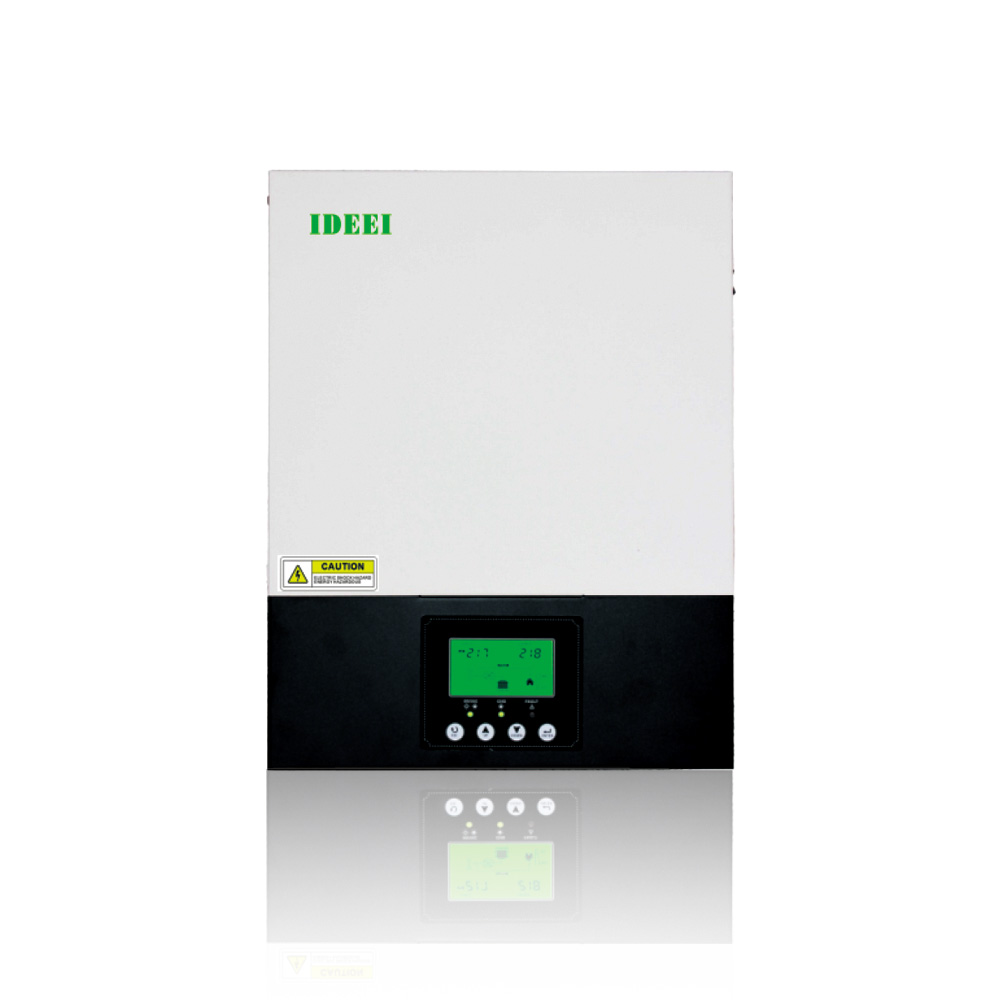
Every off-grid solar system design quietly begins with one decision: the battery voltage. Choose 24V or 48V and you have also chosen your inverter sizes, your cable thickness, your battery bank layout and, to a large extent, your upgrade path. The 24V vs 48V off grid solar inverter question has no universal winner — it has a right answer per power level and per house. This guide works through the physics first, then maps the choice onto real IDEEI models: the 24V QB15-24 and QB30-24, the cross-over QB42-24 and QB62-48, and the 48V QB82-48 and QB102-48, so you can see exactly where each voltage stops making sense.
It Is Really a Question About Current
Power is voltage multiplied by current, and current is what heats cables, sizes breakers and stresses terminals. Run the numbers on the battery side of the inverter. A 3kW load drawn from a 24V bank pulls roughly 125A before losses; the same 3kW from a 48V bank pulls about 62.5A. Double the load to 6kW and the 24V system would need around 250A — welding-cable territory, with every terminal and fuse working hard — while 48V sits near 125A, still serious but manageable with standard hardware. That single ratio explains almost everything else in this article: 24V is comfortable at small power, and its current curve, not its electronics, is what ends its useful range.
The Battery Bank: Strings, Balance and Cost
Voltage also decides how your batteries are arranged. A 24V bank built from 12V units needs two in series; a 48V bank needs four. Series strings are simple and self-balancing at small counts, but every additional parallel string you add for capacity is another set of connections to keep equal in length and tightness. For a cabin drawing a few hundred amp-hours a day, a 24V bank of two or four batteries is cheap, compact and easy to maintain. For a full house or a small farm, the same stored energy at 48V is spread over more units running at gentler individual currents, which treats the bank kindly over years of daily cycling. Neither is “better” — but buying batteries before choosing the voltage is how systems end up rebuilt within a year.
The IDEEI Range, Mapped Honestly
| System Voltage | IDEEI Models | Power | Best Fit |
|---|---|---|---|
| 24V DC | QB15-24 (MPPT 90–430V, 80A solar charging, up to 2,000W PV) | 1.5kW | Cabins, lighting, TV, small fridges, remote outposts |
| 24V DC | QB30-24 (MPPT 90–430V, 80A charging, up to 3,000W PV) | 3kW | Small homes, workshops with modest machinery |
| 24V DC | QB42-24 | 4.2kW | The top of sensible 24V: larger homes that already own a 24V bank |
| 48V DC | QB62-48 | 6.2kW | Full houses, air conditioning, farm loads |
| 48V DC | QB82-48 / QB102-48 | 8.2kW / 10.2kW | Large homes, guest houses, agricultural processing |
The QB15-24 and QB30-24 page covers the 24V pair in detail; note how both keep a wide 90–430V MPPT window and 80A of solar charging, so the array side is not the constraint at this scale. The QB42-24 and QB62-48 page is the cross-over: the same product family offered in a 4.2kW 24V version and a 6.2kW 48V version, which is the market quietly telling you where the handover happens. Above that, the QB82-48 and QB102-48 page is 48V only — at 8–10kW, nobody serious designs around 24V currents. All of these models deliver 230V AC output with MPPT solar charging as off-grid units; what changes is the DC backbone behind them.
Cables, Losses and Distance
Current is also money. Resistive loss grows with the square of current, so halving the current by moving to 48V quarters the loss in the same cable — or lets you use a much thinner, cheaper cable for the same loss. The effect is small when the inverter sits a metre from the batteries, as it should, but it becomes decisive in real buildings where the battery room, the inverter wall and the distribution board are not in the same place, and in the surge moments — a well pump or a compressor starting — when a 24V system dips its whole DC bus while a 48V system shrugs. If your design already needs long DC runs or heavy motor starts, that alone can settle the question.
Where 24V Still Wins
None of this makes 24V obsolete. For genuinely small systems — a cabin, a gate and lighting setup, a telecom shelter, a first off-grid room — 24V wins on simplicity and cost: fewer batteries in series, a huge ecosystem of 24V DC accessories and lighting, and inverters like the QB15-24 that pair a 1.5kW output with a 2,000W array and fast 80A charging. If your honest load audit stays under roughly 3kW and is unlikely to grow, 24V is the economical, maintainable choice, and the QB30-24 gives you the full 3kW with the same charging hardware. The mistake is not choosing 24V; it is choosing it for a house that will add air conditioning next summer.
Where 48V Takes Over — and the Traps Between Them
Past about 4kW of inverter, or the moment a load list includes air conditioning, a large well pump or workshop machinery, 48V takes over on every axis that matters: current, cable cost, surge behaviour and the sizes manufacturers actually offer, as the 6.2–10.2kW IDEEI models show. Two traps await switchers. First, the voltages do not mix: a 24V inverter cannot run on a 48V bank or the reverse, so changing your mind means changing the inverter and re-stringing the batteries. Second, expansion is voltage-bound — a 24V system grows by adding parallel strings and current, a 48V system grows more gracefully. Decide with the five-year load list, not the first-year one.
Frequently Asked Questions
Can I run a 48V inverter on a 24V battery bank with a converter?
Not sensibly. The inverter’s DC stage is designed for its rated battery voltage; converters at these currents waste power and add a failure point. Match the inverter to the bank — that is the entire design rule behind the QB model numbering, where the suffix (-24 or -48) states the battery class.
Is 48V dangerous compared with 24V?
Both are low-voltage DC systems, but treat either with respect: a battery bank can deliver enormous short-circuit current regardless of voltage. Correct fusing, cable sizing and terminal discipline matter more than the 24/48 choice itself.
My loads total 5kW. Which voltage should I choose?
48V. At 5kW a 24V bank would cycle at very high currents, while models like the 6.2kW QB62-48 are built exactly for that class with headroom to spare. Send us your load list and we will confirm the model and battery sizing.
Still torn between the two? Send IDEEI your load list — appliances, motors and running hours — and we will tell you plainly which side of the 24V/48V line your system belongs on, and which QB model fits it. Ask IDEEI to check your system voltage.
How to Decide Between 24V and 48V in Five Steps
- List the five-year loads, not just today’s loads. Add any air conditioner, well pump or workshop tool you expect within five years to the continuous and surge totals.
- Apply the current check. Divide watts by battery voltage. If the result is already near the practical 24V ceiling at about 4–5kW, choose 48V.
- Check the cable route. Long DC runs and heavy motor starts favour 48V, because halving current quarters loss in the same cable.
- Map the load to a QB model. Use the table above: QB15-24 at 1.5kW and QB30-24 at 3kW, QB42-24 at 4.2kW, then QB62-48 at 6.2kW, QB82-48 at 8.2kW and QB102-48 at 10.2kW.
- Plan the upgrade before you buy. If growth is likely, start at 48V or budget for an inverter change later. The staged route is set out in Should I Start at 24V or 48V for a Whole-Home Solar System?
More Frequently Asked Questions
Can I start at 24V and upgrade to 48V later without replacing anything?
No — this is the trap. Changing voltage means replacing the inverter and re-stringing the batteries. A 24V inverter cannot be paralleled or boosted into a 48V system.
Should I add panels or batteries first when my system grows?
Add panels within the model’s MPPT and array limits first, then battery capacity. The array must refill the bank daily, or a larger bank will sit part-charged.
What is the simplest upgrade decision rule?
If your five-year load list stays below about 4kW, 24V can work; if it reaches or passes about 4–5kW, or includes air conditioning or a large pump, choose 48V from the start. See the upgrade guide linked above for the full staged timeline.
For the staged upgrade timeline, see Should I Start at 24V or 48V for a Whole-Home Solar System?