
Ask three suppliers for a solar pump inverter price for the same 7.5kW borehole pump and you may receive three numbers that differ by a factor of two — for equipment that, on the surface, does the same job. The gap is rarely a trick. It is usually a specification gap: one quote includes protections, remote monitoring and a sealed cabinet, another is a bare drive in a thin enclosure; one unit is rated honestly for continuous duty in a hot pump house, another reaches its nameplate only in a cool test laboratory. This guide breaks down what actually drives the price of a solar pump inverter, factor by factor, so you can compare quotes line by line instead of number by number.
The Power Rating: The Biggest Single Price Driver
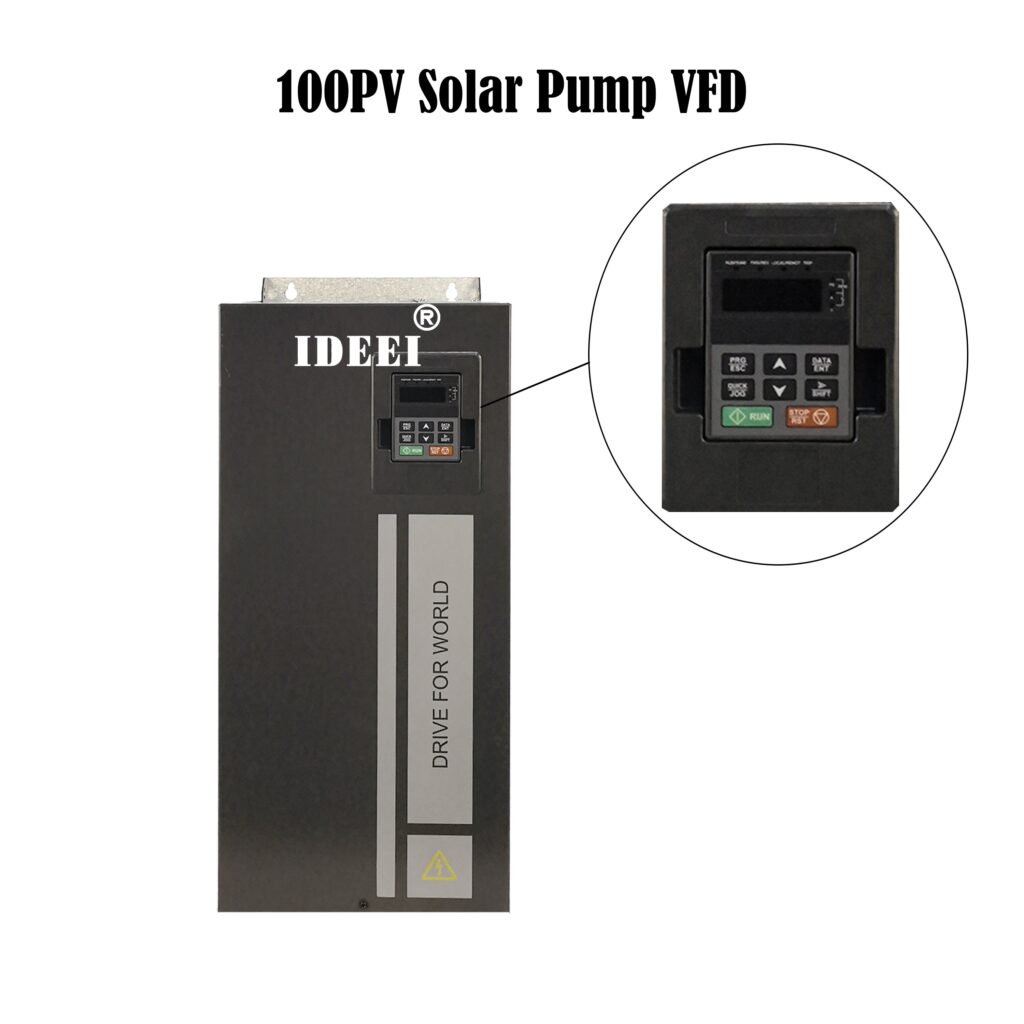
Power is the first driver, and it is not linear. Moving from 2.2kW to 4kW adds far less cost than stepping from 37kW to 45kW, because the larger step crosses a hardware platform boundary. On the IDEEI QB100-PV range, models up to 37kW sit in the plastic-shell platform, while the 45–280kW ratings move to a heavier iron-shell platform with larger terminals, bigger heatsinks and cabinet-grade construction. Semiconductor content, copper and cooling all scale with current, so a 280kW unit costs far more than ten 28kW-class units’ worth of electronics would suggest — and much more than twice a 37kW model. When you compare quotes, always compare the same rating step: a 30kW offer and a 37kW offer are not interchangeable bargains, and an oversized quote may simply be padding.
MPPT Design and DC Input Range
The second driver is the DC front end. A wide MPPT window costs money: high-voltage input stages, quality DC capacitors and accurate current sensing are not free components. The QB100-PV 400V three-phase models accept a DC 250–900V input class with MPPT tracking efficiency rated up to 99%, which lets you build longer, more efficient strings with fewer parallel runs and thinner cable. A cheaper inverter with a narrow window may force extra combiner boxes, thicker cable and more installation labour — costs that never appear in its unit price. Ask for the MPPT voltage range and the maximum PV input voltage on every quote, and price the balance of system that each window implies before deciding which offer is really cheaper.
Shell, Cabinet and Ingress Protection
Third, the enclosure. Compare the QB100-PV plastic-shell range (0.4–37kW) with the QB100-PV iron-shell range (45–280kW) and the price logic becomes visible: metalwork, ingress sealing and thermal mass. An IP54 cabinet version costs more than a basic wall-mount unit, and it earns its price where dust, insects, humidity or hose-down cleaning are part of the site reality. A low quote that silently assumes a clean electrical room is not comparable with one that includes a sealed cabinet for a dusty irrigation pump house.
Backup Capability Changes the Product, Not Just the Price
Fourth, hybrid and backup functions. A solar-only pump inverter is the simplest and cheapest architecture: it pumps when the sun shines. Adding automatic AC/DC switching, grid or generator backup and the control logic to blend or hand over between sources moves you into a different product class with more hardware and more engineering. The IDEEI S81 hybrid solar pump inverter (0.75–200kW) is built for exactly that role, with solar and grid input and automatic switching under a full protection set. Comparing an S81-class quote against a solar-only quote is comparing two different systems. Decide first whether your water demand truly needs night or cloudy-day pumping from AC, then compare prices inside that class.
Protections, Monitoring and the Cost of a Dead Pump
Fifth, the invisible items: protection functions and monitoring. Dry-run detection, water-level switching inputs, PV overvoltage, overcurrent and over-temperature handling are engineered features, and remote monitoring hardware — such as the optional GPRS module on the QB100-PV range — is a physical extra with a real cost. Price them against the alternative: a pump that runs dry over a weekend can cost more in motor repairs and lost irrigation than the entire price difference between two inverter quotes. When one quote is noticeably cheaper, ask which protections were left out, and get the answer in writing rather than discovering it at the first fault.
Freight, Terms and After-Sales: The Price Beyond the Unit
Sixth, everything around the unit itself. A price quoted ex-works is not the same as a price delivered to your farm gate: freight for a heavy iron-shell unit, export packing, duties and local taxes can reorder two quotes completely. Minimum order quantity matters for small projects — IDEEI lists its pump inverters with an MOQ of one unit, which removes the wholesale-quantity trap for single-farm projects. Finally, confirm warranty terms in writing and ask how spare parts and technical support work in your country. A drive with a clear warranty path and available parts is cheaper over ten years than a bargain unit nobody can repair.
How to Compare Quotes: A Line-by-Line Checklist
A fair comparison starts by forcing every supplier onto the same specification sheet. Manufacturers such as IDEEI confirm the exact model only after seeing the pump and site data, and publish their pump inverters as price on request — so the written quote is where the real detail lives. Check every quote against this list:
- Exact model and rating step in kW, not just a series name.
- Voltage class and phase: 220V single-phase, 220V three-phase or 400V three-phase.
- MPPT voltage range and maximum PV input voltage.
- Shell type and ingress protection; cabinet included or quoted separately.
- Protection list: dry-run, water level, overvoltage, overcurrent, over-temperature.
- Backup inputs: solar only, or AC/DC with automatic switching.
- Monitoring and accessories: GPRS module, level sensors and cables included?
- Warranty terms in writing, spare-parts availability and support scope.
Then normalise the totals: add freight, duties where they apply, the cabinet, sensors and any commissioning support to each quote before comparing. The cheapest unit price often becomes the most expensive installed price once the missing cabinet, the extra combiner box and a second site visit are added. And weigh the supplier behind the number: a factory that publishes full model tables, real DC input ranges and per-model specifications is pricing from engineering data, not from a catalogue photograph.
Frequently Asked Questions
Why do quotes for the same kW differ so much?
Because kilowatts are only one of at least six price drivers. Platform and shell, MPPT window, backup capability, protection set, monitoring hardware and warranty terms can each move the final price more than the rating step itself does.
Is the cheapest solar pump inverter a false economy?
Often, yes — when the saving comes from missing protections or a narrow MPPT window that shifts the cost into cabling, repairs and downtime. A low price for the same full specification is a genuine saving; a low price for less equipment is a different, smaller product.
What should I send to get an accurate quote?
The pump nameplate data (power, voltage, phase, current), your PV module model and planned string layout, total head, target flow, motor cable length and whether AC backup is needed. With that data, a supplier can quote an exact model and a defensible price instead of a range.
Send IDEEI your pump data and site details for a model-exact quotation you can compare line by line with any other offer. Request a quote from IDEEI.
How to Compare Quotes Step by Step
- Freeze the specification first. Write down pump power, voltage and phase, total dynamic head, PV module model and string plan, cabinet and protection requirements, and backup needs before asking for prices.
- Put every quote on the same table. Use the line-by-line checklist above and add a row for each quote; mark any missing item as not included, not as zero.
- Normalise the totals. Add freight, duties where they apply, cabinet, sensors, cables and commissioning support to each quote before comparing numbers.
- Check the rating step, not just the series name. A 30kW offer and a 37kW offer are not interchangeable, even from the same range.
- Ask what happens when something fails. Compare protection functions, warranty wording, spare parts and support scope, not only the headline price.
- Keep the 10-year question separate. Use this method to compare quotes fairly; then read What Is the 10-Year Total Cost of a Solar Water Pump? to check running and replacement costs before deciding.
More Frequently Asked Questions
Can I compare quotes by headline price alone?
No — this is the trap. A lower headline price often omits the cabinet, sensors, monitoring or protections, so the comparable total only appears after the line-by-line normalisation in the steps above.
Does the same kW rating guarantee the same scope?
No. Two quotes at the same kW can differ in MPPT window, shell, backup inputs, protection list and included accessories. Compare the specification rows, not the rating alone.
When should I look beyond the quote comparison?
When the shortlisted models are close on a like-for-like basis, check the longer view in What Is the 10-Year Total Cost of a Solar Water Pump? — running, maintenance and replacement costs can change which quote is actually cheaper over time.