
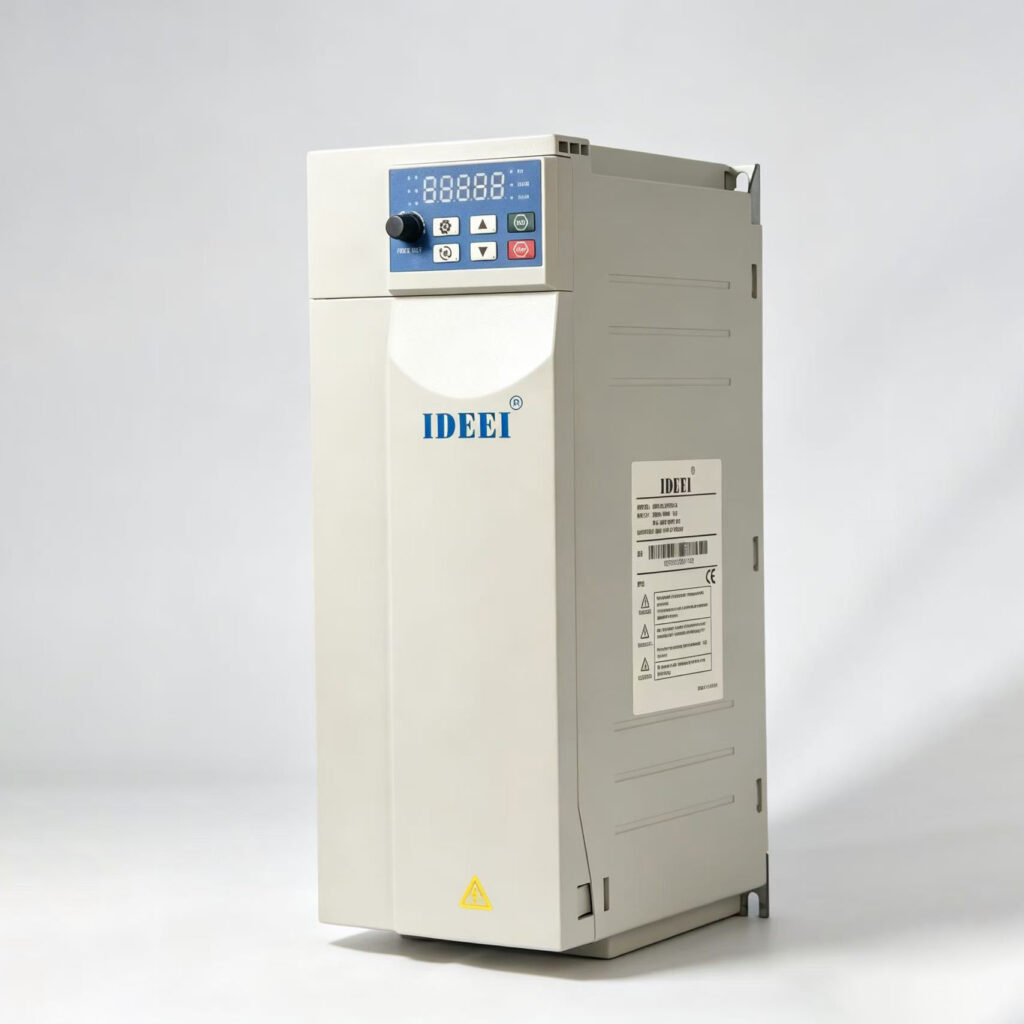
Across much of Africa, the Middle East, Latin America and southern Europe, the standard farm and industrial motor is a 380V three-phase machine — and the solar inverter that drives it has to speak exactly that language. A 3 phase solar pump inverter 380V class unit takes high-voltage DC from the array and delivers controlled three-phase AC to the motor, varying speed with the sunlight so the pump delivers water from early morning instead of waiting for full sun. This guide covers how to select the right unit and the wiring basics that decide whether it runs for a decade or trips from the first week: DC window, U/V/W motor wiring, cable sizing and the commissioning checks that matter.
What 380V Three Phase Means on a Solar Pump
Three-phase power delivers torque smoothly: three AC waveforms, offset by a third of a cycle each, keep a motor’s rotating field constant, which is why three-phase motors dominate above roughly 2.2kW and are standard for borehole and irrigation pumps. The 380V figure is the line-to-line voltage the motor is wound for (the same class is labelled 400V in many catalogues, including the IDEEI QB100-PV 400V three-phase branch — the motors are interchangeable in practice, but the inverter’s voltage class must be the three-phase 380/400V class, not a 220V model). A 220V-class inverter cannot be coaxed into running a 380V motor properly: it would deliver too little voltage, the motor would draw excess current to compensate, and the drive would trip or the motor would overheat.
Selecting the Inverter: Class, Rating and DC Window
Selection follows three checks. First, the class: motor voltage and phase must match — 380V three-phase motor, 380/400V three-phase inverter. Second, the rating: choose the inverter one step above the motor’s kW, or with roughly 25% current headroom, to absorb starting current and hot-day derating. Third, the DC window: the array must be designed into the inverter’s MPPT range. The QB100-PV 400V three-phase models (0.75–37kW) work with a DC 250–900V input class and MPPT efficiency up to 99%, so strings are long, current is low and cable losses stay small. For larger 380V pumps or projects that also need AC backup, the IDEEI S80 solar pump inverter (0.75–200kW) adds automatic AC/DC switching with dry-run and water-level protection on the same three-phase output principle.
| Pump Motor (380V 3-Phase) | Inverter Step to Choose | Array Design Note |
|---|---|---|
| 4kW | 4kW or 5.5kW | String Voc must stay under the 900V class limit; working voltage inside the MPPT window |
| 7.5kW | 7.5kW or 11kW | Array at roughly 1.3–1.6× motor power keeps morning and afternoon speed up |
| 15kW | 15kW or 18.5kW | Long strings suit the DC 250–900V class; check cold-morning Voc with the module temperature coefficient |
| 22kW | 22kW or 30kW | Consider parallel strings; verify total array current against the inverter’s PV input rating |
Wiring Basics, Step by Step
The wiring of a three-phase solar pump system is straightforward, but the order of operations matters. Work through it methodically:
- PV array to inverter (DC side). Connect the string’s positive and negative to the inverter’s PV+ and PV- terminals, observing polarity. Fit a DC isolator and surge protection device between array and inverter, and confirm the string’s open-circuit voltage — corrected for the coldest expected morning — is below the inverter’s maximum input voltage before you switch on.
- Inverter to motor (AC side). Connect the three motor leads to the U, V and W output terminals and the earth conductor to the PE/ground terminal. Never connect a 380V motor in a delta/star arrangement that contradicts its nameplate for 380V operation; the nameplate’s voltage marking governs.
- Check rotation. Phase order sets the motor’s direction. If the pump runs backwards — weak flow, no pressure — isolate the system and swap any two of the three phases at the inverter output, then retest.
- Level and dry-run sensors. Wire the well probe or float switch and the tank float to the control terminals the manual assigns to water-level and dry-run protection. These inputs are what let the drive stop before the pump runs dry and restart automatically when water returns.
- AC backup input, where fitted. On hybrid units such as the S80, the grid or generator feed lands on the dedicated AC input terminals — never on the U/V/W output. Keep DC, AC input and motor output wiring physically separate and labelled.
Cable Sizing and Voltage Drop
More solar pumping faults trace back to cable than to electronics. On the DC side, string cable is sized for the array current with UV-rated solar cable, and long runs benefit from the high-voltage design: at 600–800V DC, current — and therefore loss — is a fraction of what a low-voltage array would carry. On the motor side, the rule that matters is voltage drop over distance. A submersible pump may sit 80–150 metres below the inverter; an undersized motor cable can drop enough voltage that the motor runs hot and delivers less head, and the drive sees confusing current readings. When the run is long, go one cable size up from the bare ampacity table answer, keep joints out of the well’s splash zone, and use proper waterproof splices for the submerged section.
Commissioning Checks Before First Water
Before the first real run, verify five things in order: string polarity and Voc at the inverter terminals with a multimeter; insulation and continuity of the motor cable; the motor parameters entered in the drive (rated power, voltage, current, frequency) matching the nameplate; the dry-run and level functions tested by lifting the probe or float by hand; and rotation direction confirmed at low speed. Then let the system run a full solar day and watch how speed tracks the light: a healthy installation starts early, holds useful flow through midday, and slows gracefully in the evening instead of tripping. Record the panel configuration and parameter set — that sheet is gold for whoever services the system in five years.
Frequently Asked Questions
Can a 380V inverter run a 220V three-phase motor?
No. Voltage class is a hard match, not a setting. A 220V motor needs a 220V-class inverter, and a 380V motor needs the 380/400V class. Running a motor on the wrong class either starves it of voltage or exposes its insulation to voltage it was not built for.
How many panels make a 380V-class string?
Work backwards from voltage, not panel count: add module Voc values until the string sits comfortably inside the inverter’s window — working voltage within the MPPT range and cold-corrected Voc below the maximum (900V class on the QB100-PV 400V branch). The exact count depends on your module’s Voc and local minimum temperature.
Why does the pump stop at midday on very hot days?
Usually heat, not sunlight: the inverter derates or trips on over-temperature when its enclosure bakes in direct sun, or the array’s voltage sags below the MPPT window as the modules overheat. Shade and ventilation for the drive, and string design that keeps hot-day voltage in range, fix both.
Planning a 380V three-phase solar pumping project? Send IDEEI your motor nameplate, cable length and array plan, and our engineers will confirm the exact inverter model and string design. Contact IDEEI for wiring and selection support.