
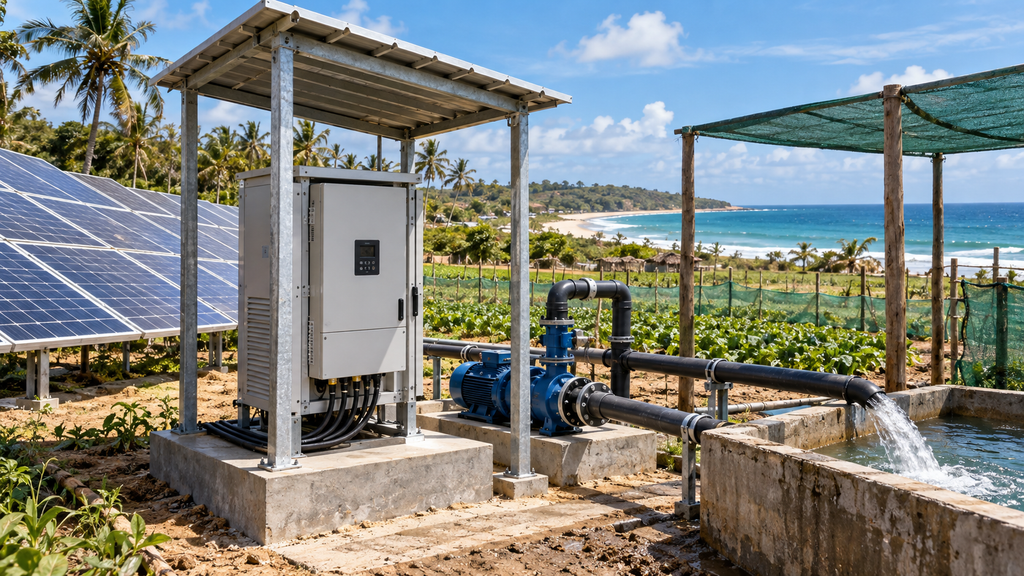
Coastal Solar Pump Inverters in Mozambique: Salt Spray, IP65, and Installation
A coastal farm in Mozambique asks more of a solar pump inverter than an inland one. The pump may be identical, the array may be identical, and the system can still fail early — because salt-laden air, humidity, and condensation attack everything the inland installation never worries about: enclosures, terminals, fasteners, and cable entries. This page is about that difference, and about the installation habits that close it.
The reference case is a coastal farm running a three-phase, 380 V, 7.5 kW pump, with solar panels providing daytime water transfer and the drive installed close to the pumping station.
The coast attacks the installation, not just the inverter
Salt damage on the coast is rarely dramatic. It is gradual, and it works through four routes:
- Airborne salt settles on surfaces. Enclosure seams, cooling fins, and exposed metal collect a salt film that holds moisture long after the air has dried.
- Humidity condenses inside. Day-night temperature swings condense moisture on and inside equipment, especially in enclosures that are sealed against rain but not against humid air.
- Terminals and fasteners corrode first. The smallest metal parts — terminal screws, gland locknuts, mounting bolts — usually show corrosion before the enclosure itself does, and a corroded terminal is a hot terminal.
- Maintenance access decides the outcome. A drive installed where nobody can inspect it will not be inspected, and on the coast, uninspected means corroding.
None of this is a reason to avoid solar pumping on the coast. It is a reason to specify the installation, not just the inverter.
IP65 is necessary here — and not sufficient
An IP65 enclosure — dust-tight, protected against water jets — is the right starting point for a coastal outdoor installation. But the rating must not be over-read, and the current product guidance is explicit on this point:
- IP65 does not establish corrosion resistance.
- IP65 does not establish salt-spray certification.
- IP65 does not establish suitability for immersion or flooding.
So the selection has two halves, and both must be satisfied: the enclosure rating of the exact model, and the corrosion behaviour of the finished installation — enclosure material and coating, mounting hardware, glands, and the shelter around it. A quotation that states only “IP65” has answered half the question.
IP65 + anti-corrosion installation checklist
Use this checklist with the installer before the order is confirmed. Every item is a decision, not a hope:
Location and shelter
- The drive sits in a sheltered position, out of direct wind-driven spray, not on the seaward face of an unsheltered wall.
- The mounting sheds water rather than pooling it; no horizontal surface above the unit drains onto it.
- The unit remains reachable for inspection and cleaning — a drive that cannot be reached will not be maintained.
Enclosure and entries
- The exact model’s enclosure rating is stated in its own datasheet.
- Cable glands match the cables actually used; every unused entry is sealed with a proper plug, not tape.
- Gland and fastener materials are corrosion-resistant for the site — specified by name, not assumed.
- Condensation is addressed: the installation plan says how moisture inside the enclosure is handled, rather than discovering it later.
Electrical integrity
- Terminals are torqued to the manual’s values and marked for re-checking.
- Earthing and surge protection are drawn on the installation plan.
- The drive’s heat can escape: a sealed enclosure still dissipates heat, and the site’s temperature limits have been checked against the model’s derating guidance.
Maintenance routine
- A cleaning and inspection routine is agreed before commissioning — what is cleaned, what is checked, and who does it.
- Terminal condition, gland seals, and enclosure coating are on the inspection list, not just fault history.
- Spare glands, fasteners, and filters (where fitted) are held on site, so a corroded small part does not idle the whole system.
The inspection interval itself should be set with the installer for the site’s exposure — a farm metres from the surf and a farm kilometres inland do not share a sensible interval, and this page does not invent one.
What to tell the supplier before ordering
A coastal quotation cannot be written from a kilowatt figure. Send:
- Motor nameplate: power, voltage, current, phase, and motor type (here: three-phase, 380 V, 7.5 kW)
- Distance from the coastline and the installation arrangement — sheltered or exposed, wall or freestanding
- Daily water volume, salinity exposure of the water itself, and wet-season access to the site
- PV module specifications and the daytime pumping window required
- Any special corrosion-protection requirement, stated before the order is confirmed — not after delivery
If a special corrosion requirement exists, it must be communicated before the order is confirmed. Retrofitting corrosion protection onto a delivered unit is rarely satisfactory and never cheap.
Frequently asked questions
Is an IP65 inverter enough for the coast?
It is the right enclosure starting point, but not the whole answer. Corrosion resistance of materials and hardware, shelter, sealing, and maintenance are separate decisions that must also be made.
Should the drive be installed indoors instead?
A sheltered indoor or semi-indoor position often helps — provided ventilation and heat dissipation are still handled. Moving a drive indoors without a thermal plan trades a corrosion problem for a heat problem.
What fails first on coastal installations?
In practice, small metal parts and seals: terminals, gland locknuts, and fasteners. That is why the checklist names them explicitly instead of trusting the enclosure alone.
Does salt air affect the solar panels too?
Panels, frames, and their fixings face the same atmosphere, and their cleaning and fastener routine belongs in the same maintenance plan. This page covers the inverter installation; the array supplier should confirm the array-side measures.