
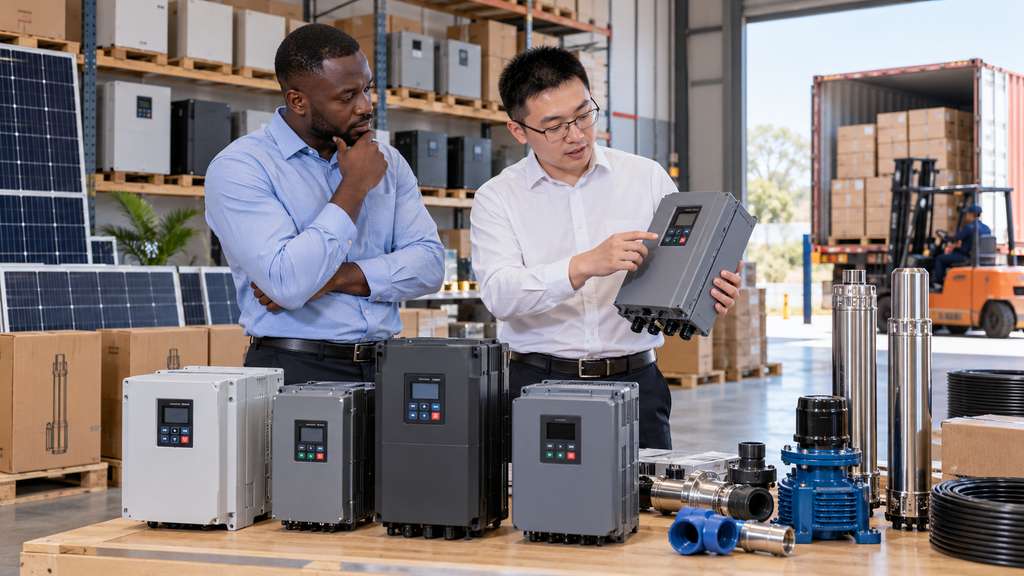
Solar Pump Inverters for Botswana: Borehole Water for Cattle Posts and Irrigation
In much of Botswana, the water point is a borehole, and the borehole is often far from the grid. That combination — groundwater, distance, and diesel cost — is exactly where solar pumping earns its place: a photovoltaic array drives the borehole pump during daylight, and an elevated tank stores the water for the hours when the sun is gone.
This page is written for Botswana farm owners, irrigation projects, and solar equipment distributors who need to select a solar pump inverter by the borehole, not by a catalogue headline.
Start from the borehole, not the kilowatt
A solar pumping plan that begins with “how many kilowatts” usually goes wrong. Begin with the borehole instead:
- Dynamic water level and pump setting depth. The pump must lift water from where the water actually sits while pumping, not from the static level measured at rest. A borehole that looks generous on paper can disappoint once the pump is running.
- Daily water volume. How much water must be delivered in a day — for cattle drinking points, for an irrigation block, or for both — sets the size of the whole system: pump, array, and tank together.
- The motor nameplate. Voltage, rated current, phase, and motor type decide which inverter can drive the pump at all. Two pumps with the same kilowatt rating can need different inverters.
- Measured values versus estimates. Mark every figure as measured or estimated before it goes into a quotation. A quotation built on an estimate should say so.
Photograph the existing pump nameplate, the old controller, and the wiring before anything is replaced. For a new installation, the borehole report and the hydraulic design are the documents a supplier actually needs.
Match the QB100-PV range to the job
The IDEEI QB100-PV family is organised in four segments, and the segment follows the motor, not the other way round:
| QB100-PV segment | Motor class | Typical Botswana use |
|---|---|---|
| S2, 0.4–7.5 kW, 220 V | Smaller three-phase borehole pumps | Cattle-post boreholes and small farm supplies |
| SS2, 0.4–5.5 kW, 220 V | Single-phase pumps in the same band | Sites where the pump and supply arrangement favour this variant |
| Three-phase, 0.75–37 kW, 380–400 V | Three-phase farm pumps | Larger boreholes and irrigation blocks |
| 45–280 kW, 400 V | Large three-phase pumps | Large irrigation schemes and multi-pump sites |
These are family segments, not a selection. The final model is confirmed against the motor’s rated current and the exact inverter’s input range — a step that belongs in writing, before an order, not after delivery.
Daytime pumping, and the tank as the battery
Solar pumping is a daytime activity, and that is a feature rather than a flaw — provided the system is designed around it. Water pumped while the sun shines is stored in an elevated tank, and the tank, not a battery bank, covers morning and evening demand. Three consequences follow:
- Tank capacity is part of the system design. It must cover the daily demand pattern, including at least one dull-weather buffer judged by the owner — not by a generic rule.
- Dry-season behaviour must be planned, not discovered. If borehole recovery slows in the dry season, the pumping rate, the tank buffer, and the low-water protection all matter more, not less.
- Batteries are a separate decision. A battery-backed arrangement is a different system with its own cost and maintenance; it should never be assumed to be included in a solar pumping quotation.
What breaks a solar pumping plan
- Selecting by motor kilowatts alone, without current, voltage class, and head.
- Sizing the array to a single sunny-day figure with no allowance for season, dust, or cable losses.
- Installing outdoor electronics without a plan for dust, heat, and rain.
- Ordering a batch before a first unit has been tested against the real borehole.
- Leaving spares, documentation, and after-sales responsibility out of the quotation.
A first-unit trial at the real site — supervised, with current, frequency, and delivered water recorded — reveals interface problems while they are still cheap to fix.
What to send IDEEI for a comparable quotation
- Motor nameplate (power, voltage, current, phase, motor type) and pump curve where available
- Borehole data: dynamic water level, pump setting depth, and daily water volume required
- Site description: location, installation environment, and distance from the grid
- Quantities, destination, and the scope expected from IDEEI — main unit, sensors, accessories, and documentation listed separately
- Whether a backup supply (grid or generator) is required, and how switching is to be handled
Send the measured figures where they exist and label the rest as estimates. A supplier who can see the assumptions can give a quotation worth comparing.
Frequently asked questions
Can one inverter run several boreholes?
As a rule, one inverter drives one pump motor. Any shared arrangement is a project design, not a standard configuration, and must be reviewed as such.
Does solar pumping work without batteries?
Yes, in the standard arrangement: the array pumps during daylight and the tank stores the water. Batteries are an additional system choice, not a default part of solar pumping.
What happens when the borehole yield drops in the dry season?
Pumping must respect the borehole’s recovery rate. Low-water protection, a realistic pumping schedule, and an adequate tank buffer are the three defences — and all three belong in the design, not in a later repair.
Can a distributor stock one range for the whole market?
The QB100-PV segments span from small single-phase borehole pumps to large three-phase schemes, so a distributor can build a range around the motor sizes its customers actually run — but the range should follow local nameplates, not a catalogue guess.