
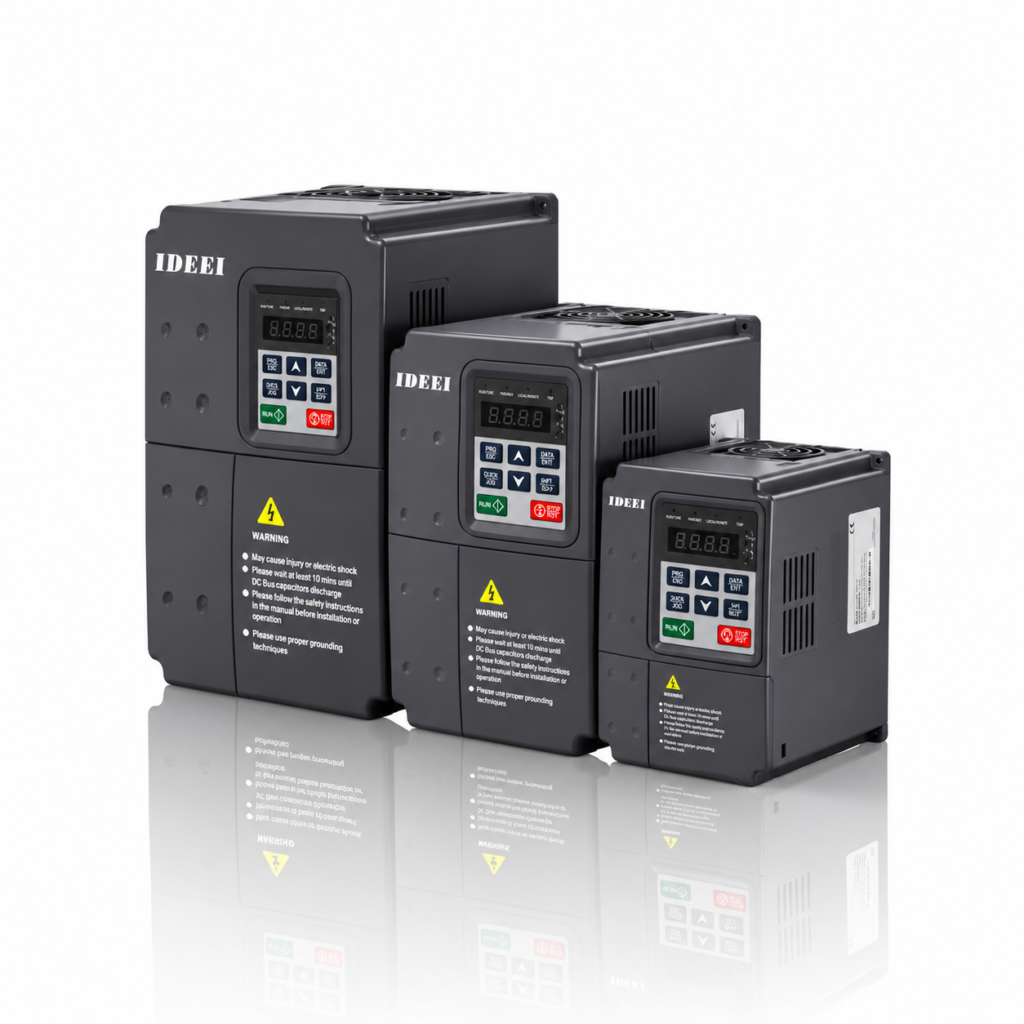
An intermittent low-voltage trip during peak production does not, by itself, prove a supply sag or an internal drive defect. First identify the exact drive, code and operating state, then compare time-aligned evidence. This worksheet helps a site team prepare an actionable service request; it is not a repair procedure or a diagnosis of a particular IDEEI model.
Start with the exact event, not a generic code list
Photograph the drive nameplate and displayed code, including subcodes. Use the manual for that model and firmware to establish what the message means. “LV,” “UV” and similar labels are not interchangeable across manufacturers. Save available fault history before resetting or changing parameters. If a measurement or setting is unavailable, write “not recorded.”
Copy this event log for each trip
| Field | Record from the site |
|---|---|
| Date, exact time and time zone | ____; note any clock difference between devices |
| Drive model, firmware and exact code | ____; attach display and nameplate photos |
| Operating stage | Starting / accelerating / steady load / stopping / source transfer |
| Supply and nearby events | Grid / generator; nearby motor start, welding load or transfer; unknown if unconfirmed |
| Stored drive readings | DC-link reading, output current and frequency if the model records them; include capture time |
| Independent supply record | Technician’s instrument, measurement location, time resolution and event file; otherwise not measured |
| Recurrence and changes | First occurrence, frequency, affected drives and recent wiring/load/parameter changes |
How to compare the evidence
- A time-aligned input-voltage disturbance: ask a qualified technician to assess the supply path and installation against the exact manual. A matching event is evidence to investigate, not proof that every drive component is healthy.
- Several drives trip together: a shared source or switching event deserves attention, but common timing alone does not identify the failed item.
- No disturbance in the available record: check whether the instrument covered the relevant conductors, location and time interval. A slow average or a measurement taken after the trip can miss a short event.
- A repeated event on one drive: submit the supply record and drive history for model-specific service review. A low DC-link indication alone does not identify a capacitor, rectifier or control-board fault.
Do not make the trip disappear by changing protection
Do not raise limits, extend delays, enable automatic restart or repeatedly reset the drive as a substitute for finding the cause. Electrical measurements, isolation and internal inspection belong to qualified personnel using the manufacturer’s procedure. Follow the site’s safe-stop process where operation could endanger people or equipment.
What to send for technical review
Attach the completed event log, motor nameplate, single-line supply diagram, relevant parameter backup and original instrument files. Separate observations from assumptions: “another motor started at 14:02” is an observation; “it damaged the DC bus” needs evidence. State the production constraint and available shutdown window so the next inspection can be planned.
Questions buyers and maintenance teams ask
Is a normal voltage reading after the trip enough?
No. It describes that later measurement, not necessarily the brief conditions at the trip.
Does a low-voltage code mean the drive needs replacing?
No. Establish the code meaning and compare supply and drive evidence before selecting a repair or replacement.
For the wider sequence, use our VFD fault-recording guide. Send the event package to IDEEI technical support.
Reference example: the Danfoss VLT HVAC Drive Design Guide documents model-specific DC-undervoltage conditions. Its codes, limits and delays must not be copied to an IDEEI drive. The worksheet above is an IDEEI editorial tool, not a recorded customer case.