
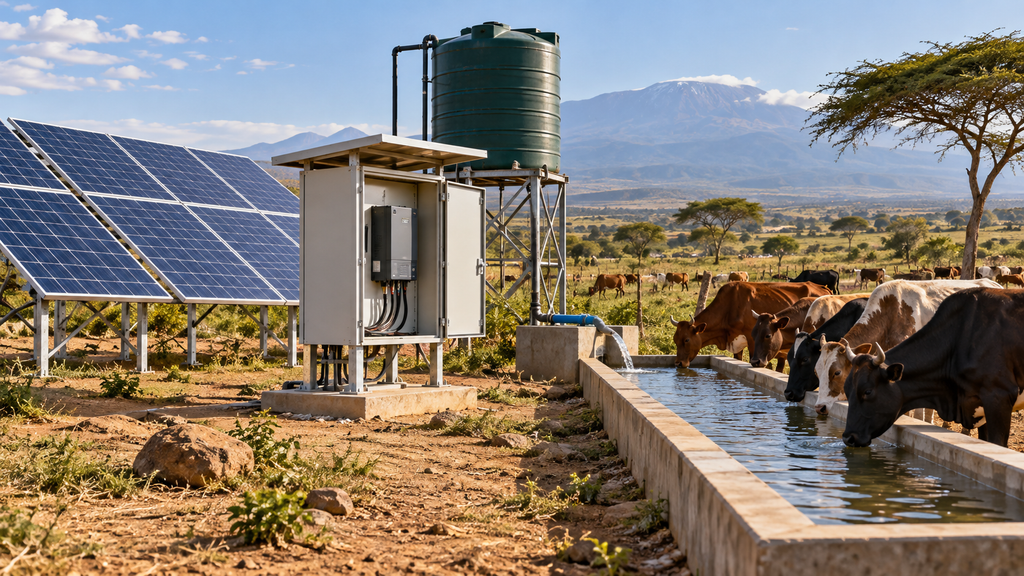
A 5.5 kW IP65 Solar Pump Inverter for a Tanzanian Livestock Farm
A livestock farm’s water system has one unforgiving property: the animals drink every day, including the days when the weather, the well, or the equipment does not cooperate. This page works through a concrete case — a Tanzanian livestock farm running a three-phase 5.5 kW pump — and shows how water demand, dry-season well behaviour, and an IP65 enclosure decision fit together.
The livestock day sets the demand
Start with the drinking points, not the pump. A farm’s daily water need is the sum of what every drinking point must deliver across the day, plus the reserve the farm wants in the tank. The honest way to size it:
- Count the animals and the points. Herd size by group, and every trough the system must keep full.
- Work out daily need per group. Daily water need per animal varies with animal type, size, temperature, and feed — so it must be taken from the farm’s own records or a local veterinary reference, never from a generic internet figure.
- Add the pattern, not just the total. Morning and evening peaks decide the tank size and the pumping window; a daily total alone hides both.
- Separate measured from estimated. If the farm has metered its water use, use that. If it has not, say so, and size with an explicit margin the owner has agreed.
A single motor kilowatt figure does not establish any of this. The 5.5 kW rating is the starting point of the electrical discussion, not the answer to the water discussion.
Dry-season well recovery governs the schedule
In the dry season, two things change at once: the animals still need the same water, and the well recovers more slowly. That combination is where livestock systems fail, and it is governed by one comparison:
- Pumping rate versus recovery rate. If the pump draws faster than the well recovers, the water level falls while pumping, the pump risks running dry, and the day’s water is not delivered. The pumping schedule — run periods, rest periods, and the tank buffer — must be set so the well is never asked for more than it can give back.
- The tank is the buffer. A tank sized for a normal day is not automatically sized for a dry-season day. The buffer must cover the gap between what the well can deliver in a solar day and what the animals need that day.
- Low-water protection is not optional. A level control that stops the pump before it runs dry protects both the pump and the next day’s supply. It belongs in the quotation scope, listed as its own item, not assumed.
Ask the owner and the site engineer for the well’s dry-season behaviour in writing: how far the level falls during a pumping run, and how long it takes to recover. Estimates labelled as estimates are useful; estimates presented as measurements are dangerous.
IP65 selection: what the rating means, and what it does not
IP65 is an enclosure rating with a precise meaning: dust-tight, and protected against water jets from any direction. For an outdoor livestock installation — dust, rain, and wash-down around troughs — that is a meaningful rating. It is not a general promise of outdoor invulnerability:
| Question | IP65 answer |
|---|---|
| Dust ingress | Protected — dust-tight under test conditions |
| Rain and water jets | Protected — against jets from any direction |
| Flooding or immersion | Not covered — IP65 is not an immersion rating |
| Corrosion or salt resistance | Not covered — a separate material and coating question |
| Heat inside a sealed box | Must be checked — a sealed enclosure still has to shed the drive’s heat |
| The finished installation’s rating | Only as good as its weakest entry — glands, connectors, and covers included |
Selection checklist for the exact model, not the family:
- The exact model’s enclosure rating is stated in its own datasheet — not inferred from a family name.
- Cable glands match the cables actually used, and every unused entry is sealed.
- The mounting position sheds rain rather than collecting it, and the unit is reachable for inspection.
- Ventilation and temperature limits for the site have been checked against the model’s derating guidance.
- UV exposure, dust build-up on cooling surfaces, and a cleaning routine are in the maintenance plan.
- Earthing, protective devices, and water-level controls are listed in the quotation scope.
An indoor-rated inverter on a wet outdoor wall is not a bargain; it is a failure waiting for the first storm.
Putting the 5.5 kW system together
For this farm’s case — a three-phase 5.5 kW pump, a storage tank, and several drinking points — the selection sequence is:
- Confirm the motor nameplate: voltage, rated current, phase, and motor type.
- Confirm the inverter model that matches that motor at the site’s voltage class, with an IP65 enclosure rating stated for that exact model.
- Size the array to the pumping window the farm actually needs, allowing for season, dust, and cable losses.
- Size the tank to the daily pattern plus the dry-season buffer.
- List the controls as separate items: tank level control, low-water protection, and any alarm the farm wants.
- Agree a first-unit acceptance test: normal start, steady running, controlled stop, and the response to a lost signal or a low-water event — all recorded, not assumed.
Only qualified personnel should wire, commission, and modify the installation, and only against the manual of the exact unit supplied.
Frequently asked questions
Does IP65 mean the inverter can be installed anywhere outdoors?
No. It means the enclosure passed dust and water-jet tests. Flooding, immersion, corrosive atmospheres, and blocked ventilation are separate questions, and each must be answered for the specific site.
What is the most common mistake in livestock solar pumping?
Sizing from the pump’s kilowatt rating alone. Water demand per animal, dry-season well recovery, and the tank buffer decide whether the system works; the kilowatt rating only starts the electrical conversation.
Does the system work in the rainy season?
Rain changes the water balance but rarely removes the need for pumped water, and overcast days reduce solar output. The tank buffer and the pumping schedule should be judged against the dullest expected days, not the brightest.
What should a quotation list separately?
The main unit, sensors, level controls, protective devices, cabinet or shelter, cables and glands, documentation, and freight — each as its own line, so two quotations can actually be compared.
What does IDEEI need to confirm a 5.5 kW configuration?
The pump nameplate, the farm’s daily water figures (measured where possible), the well’s dry-season behaviour, site photographs, the PV module data, and the destination in Tanzania.